The morning light had barely touched the horizon when 64-year-old farmer Thomas stepped into his soybean fields, boots sinking softly into the damp earth. The rain from the night before left a glossy sheen across every leaf, with droplets reflecting the first streaks of gold rising in the east. Puddles gathered in low spots, tiny mirrors to the waking sky.
It was a ritual he had followed for decades. Coffee in hand, hat pulled low, he walked the perimeter of his land before the machinery stirred. Those early hours were his alone—a quiet communion with soil, seed, and sky.
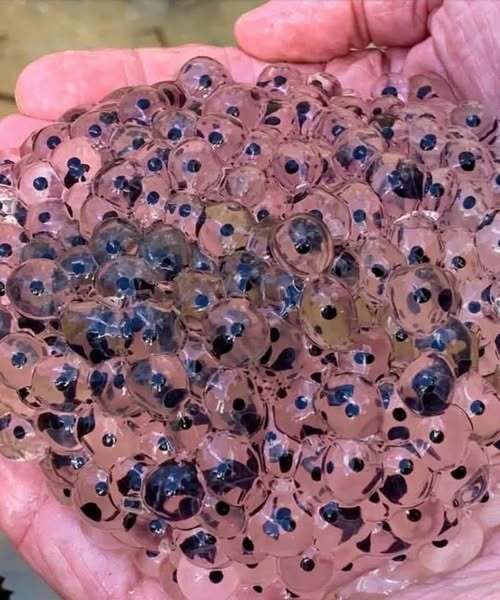
That morning, however, something unusual drew him to a shallow dip in the field where water often pooled. Nestled in the mud were dozens of tiny, translucent spheres, shimmering with a faint bluish tint. They clustered together like fragile beads of jelly.
Thomas crouched carefully. They were too large to be insect eggs, too delicate for any bird to have laid. Having spent a lifetime observing deer tracks, fox dens, and barn owl nests, he recognized that this was something entirely new. Rather than disturb them, he photographed the cluster and reached out to a biologist he had met years ago at a county fair.
By the next morning, she arrived with two colleagues. After examining the tiny orbs, their excitement was immediate. “These are tree frog eggs,” the lead researcher explained. “A species not previously documented in this area.” The damp depression in Thomas’s field had become an unexpected nursery, brought by warmer temperatures and shifting rainfall patterns that quietly expanded the frogs’ habitat.
Over the following weeks, Thomas watched as the eggs hatched into tadpoles, their tiny tails flicking through the shallow water. Inspired by the fragile life under his care, he carved a small pond nearby, providing a safe home for the growing amphibians.
By summer’s end, the field echoed with the cheerful chirps of frogs hidden among the grasses. What began as a simple walk in the early light had become a lesson in observation, patience, and stewardship.
Thomas hadn’t set out to make a difference. Yet, by noticing something small and choosing care over convenience, he allowed nature to thrive—and witnessed a quiet miracle unfold in his own backyard.
Leave a Reply