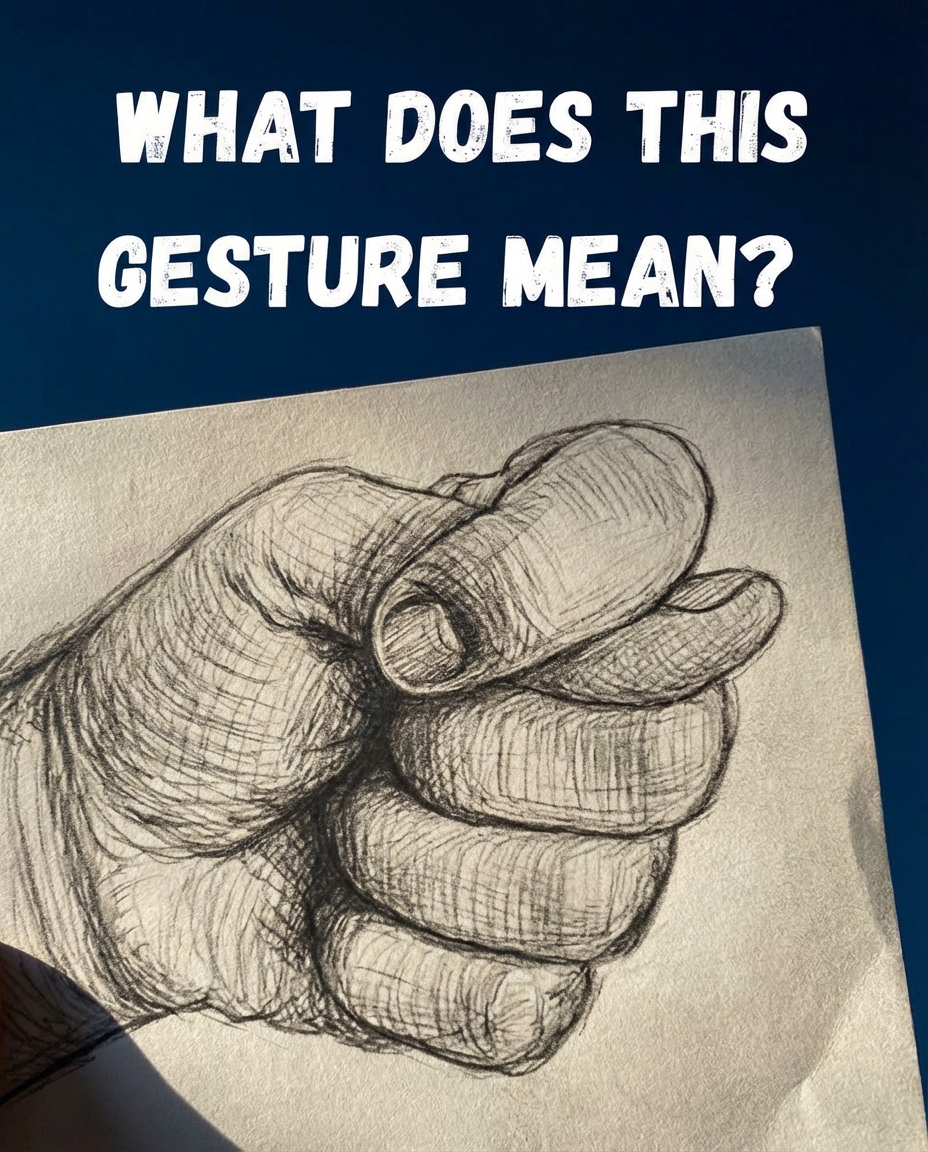
What appears at first to be a simple clenched fist reveals something far more expressive when examined closely. With the thumb tucked firmly between the index and middle fingers, the hand forms a gesture known as the fig. This small adjustment transforms an ordinary pose into a symbol layered with meaning. Long before digital communication shaped daily interaction, such gestures carried messages that required no spoken explanation.
The fig gesture, sometimes called the “fig sign,” has deep roots in European history. In many communities, it functioned as a discreet way to refuse a request or push back against authority. Instead of open disagreement, a person could use this subtle motion to communicate defiance without escalating conflict. The hand remained closed, but the hidden thumb quietly declared independence.
During the nineteenth century, especially in rural European villages, the gesture gained social nuance. Life in small communities often required diplomacy, and overt confrontation could strain relationships. The fig allowed individuals to maintain politeness on the surface while privately asserting boundaries. It balanced humor with resistance, offering a socially acceptable outlet for frustration.
Symbolically, the gesture carried protective associations. Folklore in various regions linked it to warding off bad luck or shielding against harmful intentions. The closed fist represented strength, while the thumb enclosed within suggested guarded protection. In this way, the sign blended everyday communication with hints of superstition and cultural belief.
Over time, the fig gesture moved beyond public resistance and into domestic life. Families adopted it as a playful signal between relatives, especially among children and grandparents. It became a lighthearted way to say “no,” to tease gently, or to encourage resilience in moments of uncertainty. Within homes, its meaning softened into affection and humor.
Children, in particular, embraced the gesture as part of games and secret exchanges. It served as a code understood within a small circle, reinforcing bonds and shared understanding. Because it required no words, it could be used across distances or in situations where silence was necessary. This adaptability made it both practical and intimate.
As communication technologies evolved, physical gestures like the fig gradually faded from common use. Text messages, reaction icons, and social media comments replaced many forms of face-to-face symbolism. The efficiency of digital tools left less room for subtle, embodied expressions that once conveyed layered emotions.
Even so, the fig gesture remains a testament to human creativity in nonverbal communication. It reminds us that strength, humor, and refusal can be expressed quietly yet effectively. Though small and easily overlooked, such gestures reflect a time when meaning was carried not only in words, but also in the silent language of the hands.
Leave a Reply