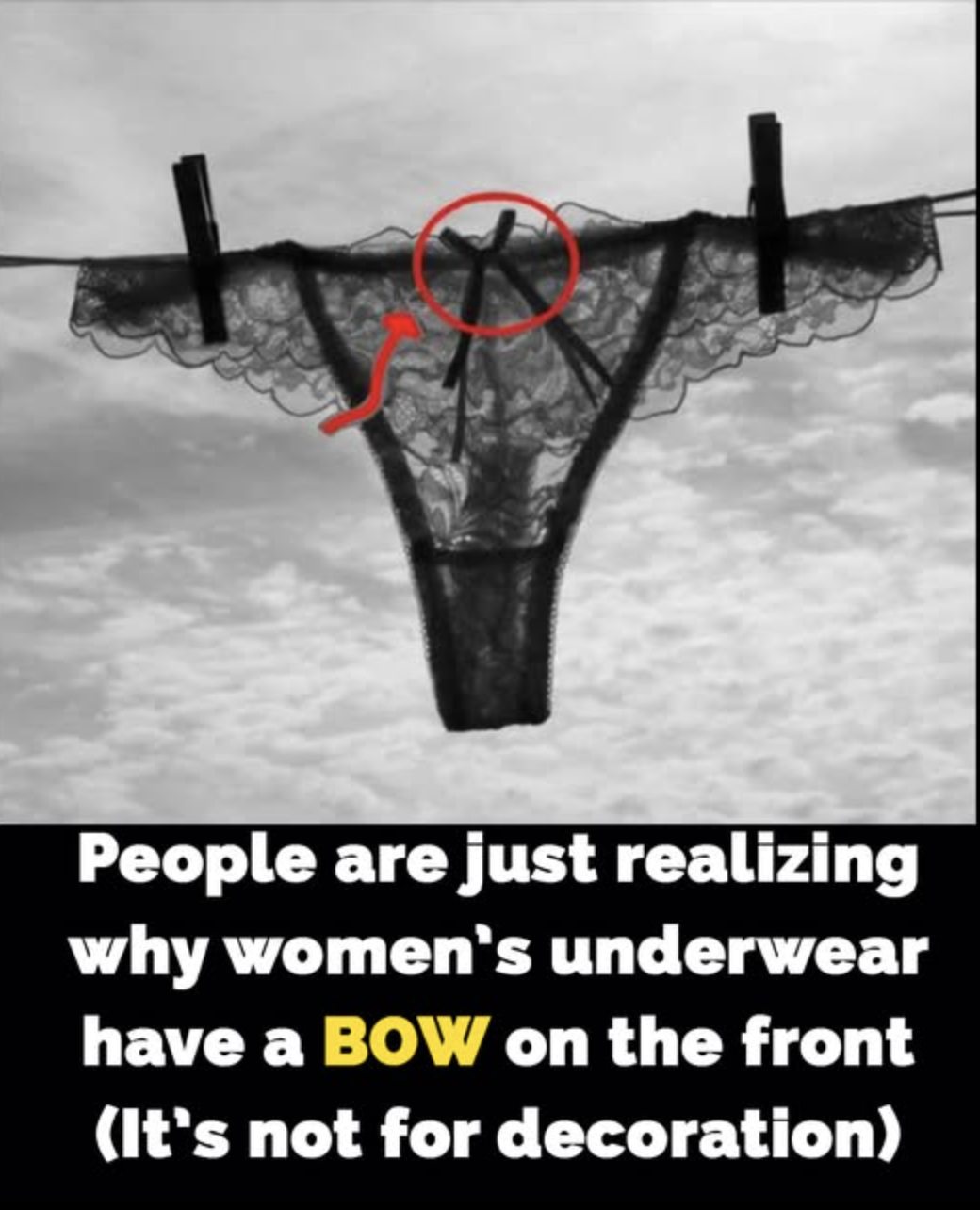
Have you ever spotted the tiny bow stitched onto the front of women’s underwear and wondered why it’s there? At first glance, it appears to be nothing more than a sweet decorative touch. Many assume it was added simply to make lingerie look softer or more feminine. Yet that small ribbon detail actually traces back to a time when clothing functioned very differently from what we know today.
Centuries ago, before elastic waistbands were invented, undergarments had to be secured with ribbons or drawstrings. Early versions of women’s “drawers” were often made in two separate pieces and fastened together at the waist. The fastening typically sat at the front, where it could be easily tied and adjusted. The loose ends were then formed into a bow to keep the knot tidy and prevent it from unraveling.
The bow was not merely ornamental — it served a practical purpose. By covering the knot, it reduced bulk beneath outer clothing and gave the garment a neater appearance. In an era when craftsmanship and presentation mattered, even hidden layers were expected to look refined. What seems decorative now was once an essential finishing touch.
Lighting conditions also played a surprising role in the bow’s usefulness. Before electricity became common in homes, people often dressed by candlelight, oil lamps, or faint early-morning light. In dim settings, it could be difficult to quickly tell the front of a garment from the back. The small bow provided a simple tactile clue, allowing wearers to identify the correct side without relying on sight.
As textile technology advanced in the late 19th and early 20th centuries, elastic gradually replaced drawstrings. Waistbands became stretchable, and undergarments no longer required front ties. Despite this shift, the bow did not disappear. Instead, it remained as a subtle nod to the garment’s earlier construction.
Over time, the function of the bow faded while its symbolism grew. Designers embraced it as a marker of delicacy and tradition. The detail began to represent classic lingerie styling — something soft, graceful, and timeless. What once secured fabric in place evolved into a visual signature associated with femininity and charm.
Today, opinions about the tiny bow vary. Some people appreciate it as a nostalgic detail that connects modern fashion to its historical roots. Others see it as unnecessary and remove it for a sleeker look. Still, many are surprised to learn that such a small accent carries a practical origin story rather than being purely decorative.
Ultimately, the bow on women’s underwear is a reminder that fashion often preserves fragments of the past. Garments change as technology and lifestyles evolve, but certain details linger long after their original purpose fades. That modest ribbon is more than a cute embellishment — it is a quiet piece of clothing history, stitched into everyday life.
Leave a Reply