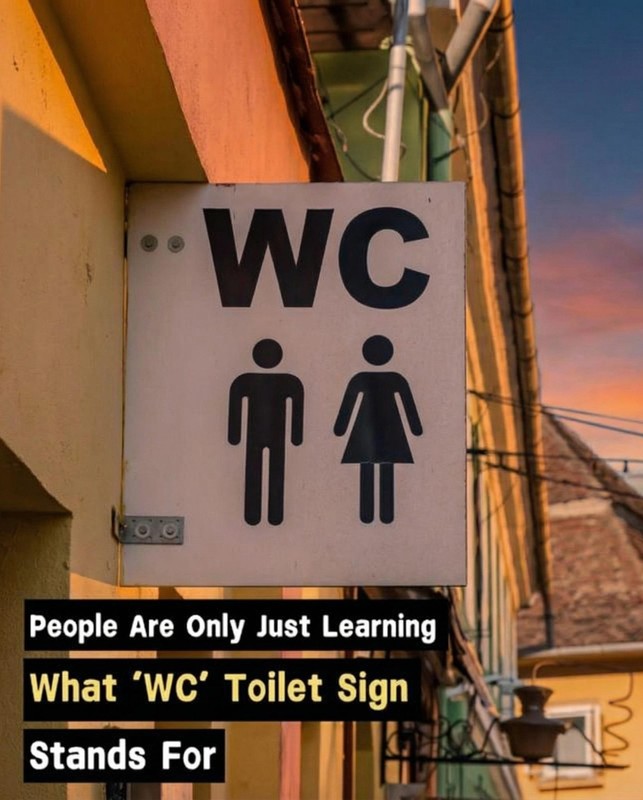
Have you ever noticed the letters “WC” on a public door and paused for a moment of confusion? While many people are more accustomed to seeing signs labeled “bathroom” or “restroom,” the abbreviation “WC” continues to appear in airports, hotels, and restaurants around the world. For travelers especially, it can spark curiosity about its meaning and origin.
The term “WC” stands for “water closet,” a phrase that dates back to 19th-century Europe. During that time, indoor plumbing was still a groundbreaking development. In countries such as England, the water closet referred to a small, enclosed room containing a flushing toilet — a significant improvement over outdoor privies and chamber pots that were previously common.
The invention of the flushing toilet marked a turning point in sanitation and urban living. Having a private indoor space with running water improved hygiene standards and reduced the spread of disease. As homes and public buildings modernized, the “water closet” became a symbol of technological progress and social advancement.
Language evolved alongside these architectural changes. In the United States, the word “bathroom” became widely used, even in spaces that did not contain a bathtub. “Restroom” also gained popularity, offering a more polite and indirect way to refer to toilet facilities in public settings. Meanwhile, “WC” remained a standard abbreviation across the United Kingdom and much of continental Europe.
Over time, the letters “WC” transformed into a universal symbol. Even in places where English is not the primary language, the abbreviation appears on signage to guide visitors. Its simplicity makes it easy to recognize in multilingual environments, particularly in transportation hubs and tourist destinations.
The continued use of “WC” also reflects cultural attitudes toward discretion. Rather than explicitly naming the function of the room, the abbreviation provides a neutral, almost coded reference. This subtlety has helped it endure across generations and borders.
Today, whether displayed in a historic European café or a modern international airport, “WC” serves as a quiet reminder of how far sanitation has progressed. What once represented cutting-edge plumbing is now an everyday convenience taken for granted.
So the next time you see those two letters on a door, you’ll know they carry more than a simple direction. They reflect centuries of innovation, changing social norms, and the fascinating way language adapts to new technologies and shared human needs.
Leave a Reply