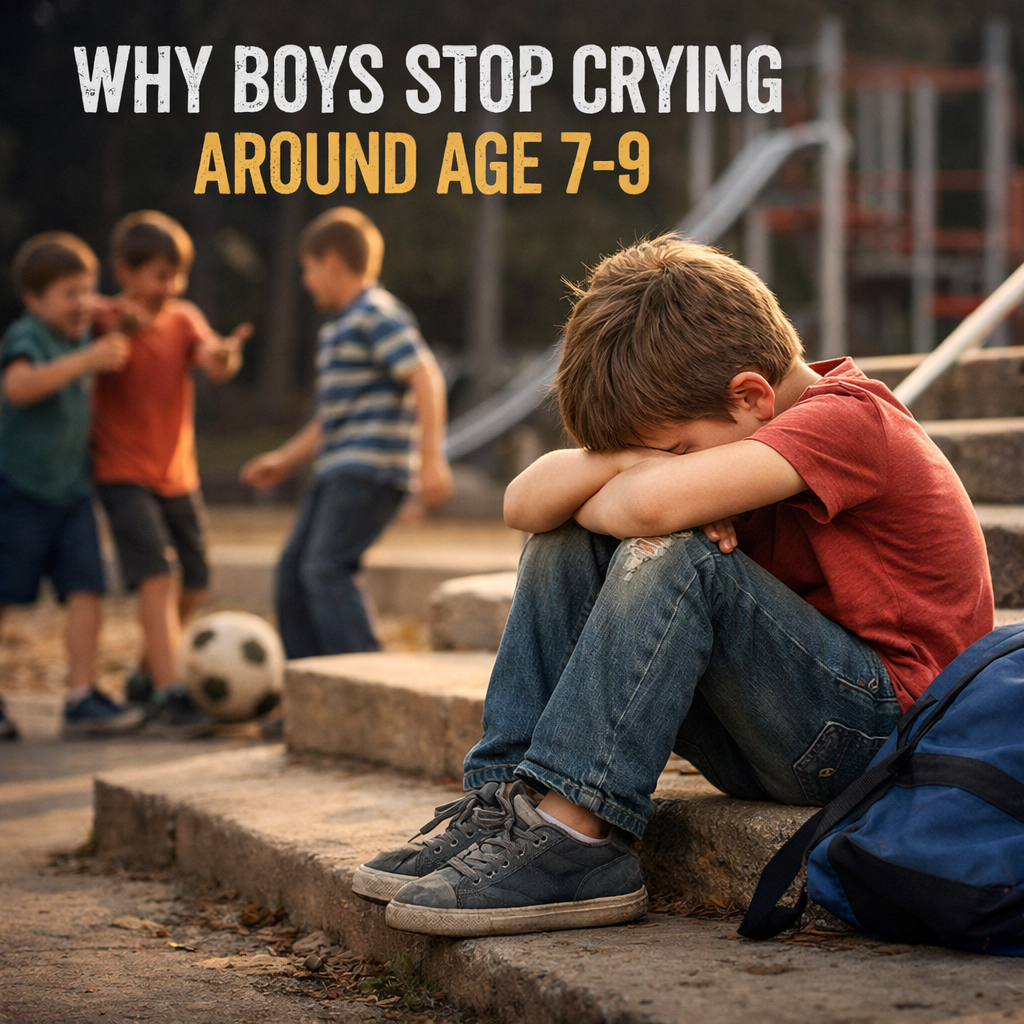
Most boys don’t stop crying because they suddenly become stronger. They stop because they realize something has changed. Around age 7 to 9, many boys experience a subtle but powerful shift: the world reacts differently to their emotions. The same tears that once brought comfort now bring discomfort, teasing, or silence.
At that age, boys become hyper-aware of social rules. School playgrounds become training grounds for masculinity. A boy who cries after falling down might hear, “You’re fine,” instead of “That hurt, huh?” He learns quickly that pain is acceptable — but showing it isn’t. The message isn’t always cruel. Sometimes it’s casual. But it sticks.
Psychologists call this gender role socialization. It’s the process where children absorb unspoken expectations about how they “should” behave. Girls are often allowed emotional range. Boys are often allowed anger — but not sadness, fear, or vulnerability. So the emotional spectrum narrows.
By middle childhood, peer approval becomes survival. Boys begin policing each other. “Don’t be soft.” “Man up.” “Stop acting like a baby.” None of them invented these rules — they’re just enforcing them. And the cost of breaking them is social exclusion.
Something else happens too: fathers and male role models often model emotional restraint. Many men grew up under the same rules. They weren’t taught to process feelings; they were taught to contain them. So boys don’t just hear the lesson — they see it lived out.
Over time, crying doesn’t disappear. It goes underground. Sadness becomes irritability. Fear becomes defensiveness. Shame becomes anger. This is why so many adult men struggle to identify what they’re feeling beyond “stressed” or “mad.” The emotional vocabulary was cut short early.
The real tragedy isn’t that boys cry less. It’s that they feel alone more. When emotional expression is discouraged, connection weakens. And without connection, boys grow into men who believe vulnerability is weakness — even when it’s the very thing that builds intimacy and trust.
The good news is this: emotional suppression is learned, which means it can be unlearned. When boys are given language for their feelings and space to express them without ridicule, they don’t become fragile. They become regulated. And regulated boys grow into men who don’t have to choose between strength and softness — because they understand both.
Leave a Reply