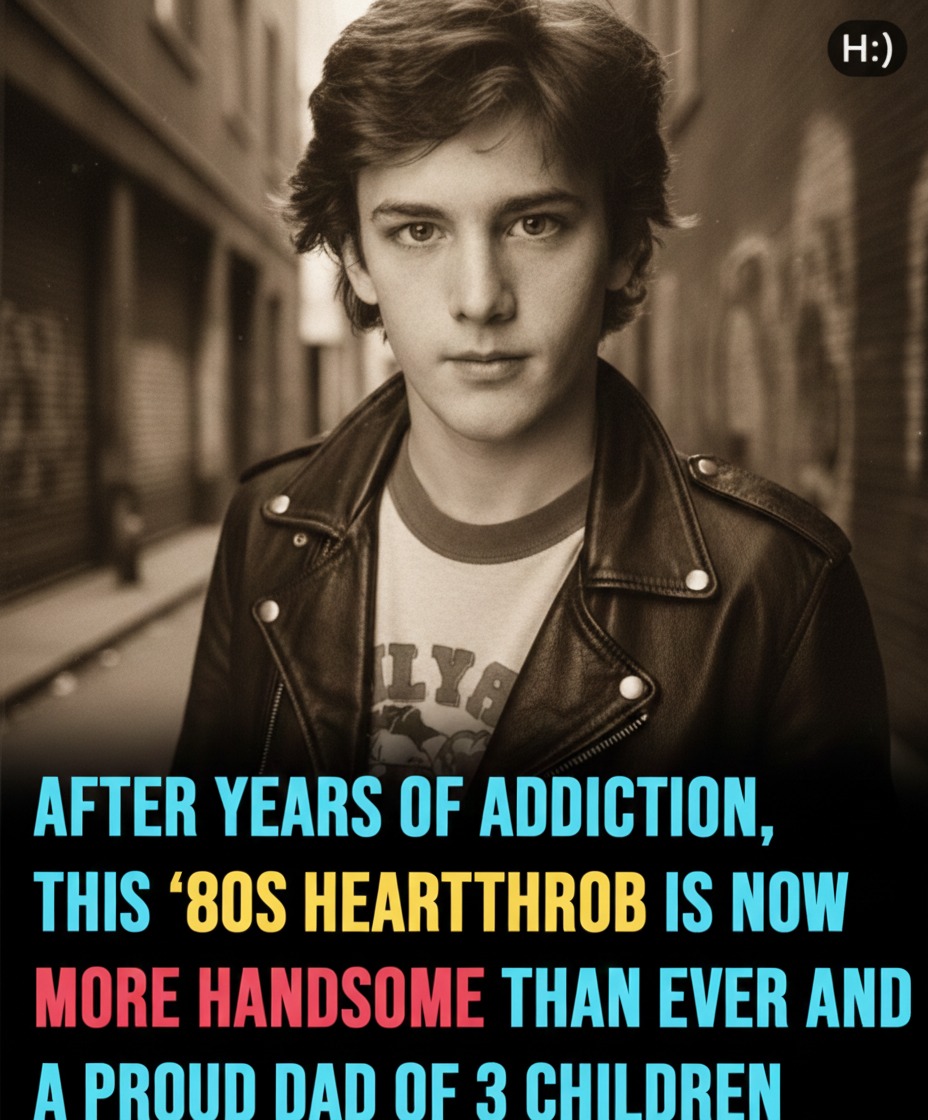
He was once the face that launched a thousand crushes, the quietly intense young actor whose photograph was taped inside lockers and slipped between the pages of spiral notebooks across America. With tousled dark hair, searching eyes, and a softness that felt almost confessional, Andrew McCarthy became one of the defining symbols of 1980s teen cinema. On screen, he radiated vulnerability and restrained longing, the kind of romantic presence that made audiences feel as though he was speaking directly to them. Yet the polished movie stills and glossy magazine spreads concealed a far more complicated reality. Behind the carefully lit close-ups was a young man grappling with insecurity, loneliness, and a growing dependence on alcohol that would nearly derail his life. His journey from suburban New Jersey to Hollywood stardom was neither smooth nor predictable, and the years that followed would test him in ways more dramatic than any screenplay. The real intrigue of his story lies not in the fame he achieved so quickly, but in the battles he fought away from the cameras and the reinvention that allowed him to build a second, more grounded life. While many remember him as the sensitive heartthrob of a generation, the deeper narrative is one of resilience, self-examination, and ultimately, transformation.
Born in 1962 in Westfield, New Jersey, McCarthy grew up in a middle-class family far removed from the glamour of Los Angeles. His mother worked at a newspaper, his father in investments, and there were no family ties to the entertainment industry. Acting entered his life not as a calculated career move but as a refuge. As a teenager, he often felt disconnected from his peers, describing a persistent sense of not quite belonging. Performing offered him a structured way to channel emotions that felt overwhelming in everyday life. After high school, he enrolled at New York University to study acting, but discipline eluded him. He skipped classes, drifted, and was eventually expelled. Then came a moment of improbable luck: an open casting call for the film Class. Competing against hundreds of hopefuls, he landed a role opposite Jacqueline Bisset, an experience so surreal it seemed to rewrite his trajectory overnight. One week he was a struggling student; the next he was starring in a major studio production. The film’s success brought attention, validation, and a sudden sense of forward momentum. When NYU offered to readmit him and treat the movie as independent study credit, he declined with defiant confidence. Hollywood had opened its doors, and he walked through them without looking back.
The mid-1980s cemented his status as a leading figure in youth-oriented cinema. He starred in St. Elmo’s Fire, sharing the screen with a cluster of rising actors who would become emblematic of the era. Soon after came Pretty in Pink, where his portrayal of the introspective Blane opposite Molly Ringwald solidified his image as the sensitive romantic lead. Films like Mannequin and Weekend at Bernie’s further expanded his popularity. The media grouped him with contemporaries under the banner of the “Brat Pack,” a label that often suggested entitlement and excess, whether accurate or not. For McCarthy, the attention was overwhelming. He has since admitted that he was temperamentally unsuited for sudden fame. Praise felt intrusive rather than empowering. Public scrutiny intensified his self-doubt instead of soothing it. As his career accelerated, so did his drinking. Alcohol became a coping mechanism, a way to quiet anxiety and project confidence he did not truly feel. On screen, audiences saw composure and sensitivity; off screen, he battled hangovers and insecurity. He later reflected that during the filming of Pretty in Pink, he was frequently so hungover he could barely function, yet the camera translated his exhaustion into brooding charm. The disconnect between public perception and private reality widened with each success.
By the late 1980s, the cracks could no longer be ignored. Just before filming Weekend at Bernie’s, he attempted to quit drinking, sensing the trajectory was unsustainable. Sobriety, however, proved elusive. A single drink on a film set reignited old patterns, leading to several more painful years of relapse. The glamorous façade of Hollywood could not mask the internal collapse he was experiencing. Eventually, he hit a physical and emotional low point that forced a reckoning. At 29, he entered rehabilitation, committed to detox, and began the long process of rebuilding. Recovery did not bring instant clarity or serenity, but it offered something more durable: accountability and perspective. He has spoken about being comfortable in solitude, suggesting that learning to sit with himself without distraction became a crucial part of healing. In an industry notorious for excess and burnout, his decision to step back rather than self-destruct quietly distinguished him from many peers. Instead of clinging to fading teen-idol status, he allowed himself to evolve. That willingness to change direction marked the beginning of a second act defined less by celebrity and more by substance.
As the 1990s and 2000s unfolded, McCarthy gradually shifted away from center-stage acting roles and into new creative territories. He began directing television, eventually helming episodes of acclaimed series such as Orange Is the New Black and Gossip Girl. Behind the camera, he found a different kind of fulfillment—one rooted in collaboration and craftsmanship rather than personal spotlight. At the same time, he discovered a passion for travel writing. What began as curiosity evolved into a respected parallel career. In 2010, he was named Travel Journalist of the Year by the Society of American Travel Writers, a recognition that affirmed his legitimacy beyond Hollywood. For him, acting and writing were not opposites but variations of storytelling. Travel sharpened his senses and pulled him outward, encouraging presence rather than introspection. He described feeling more alive and attuned when navigating unfamiliar places, as though movement itself clarified his thinking. This creative reinvention demonstrated that identity need not be confined to early success. Where once he had relied on scripts written by others, he now crafted narratives in his own voice.
His personal life, too, unfolded in chapters of growth and recalibration. After reconnecting with his college sweetheart, Carol Schneider, he married in 1999, and they welcomed a son before eventually divorcing. Later, he married Irish writer and director Dolores Rice, with whom he has two more children. Fatherhood became a grounding force, reshaping priorities and softening old ambitions. Today, he lives in New York’s West Village, directing, writing, and raising his family with a steadiness that contrasts sharply with his early fame. Fans still celebrate his youthful performances, often expressing nostalgia for the films that defined their adolescence. He acknowledges their affection with gratitude but rarely indulges in sentimentality himself. The past, he suggests, belongs more to the audience than to him. His features may now be more lined, his expression more contemplative, yet there is a quiet assurance that was absent in his twenties. The true arc of his life is not the meteoric rise of a teen idol but the deliberate shaping of a second identity—one forged through recovery, reinvention, and resilience. In surviving Hollywood and stepping beyond it, Andrew McCarthy proved that the most compelling story is not the height of fame but the courage to outgrow it and build something deeper in its place.
Leave a Reply