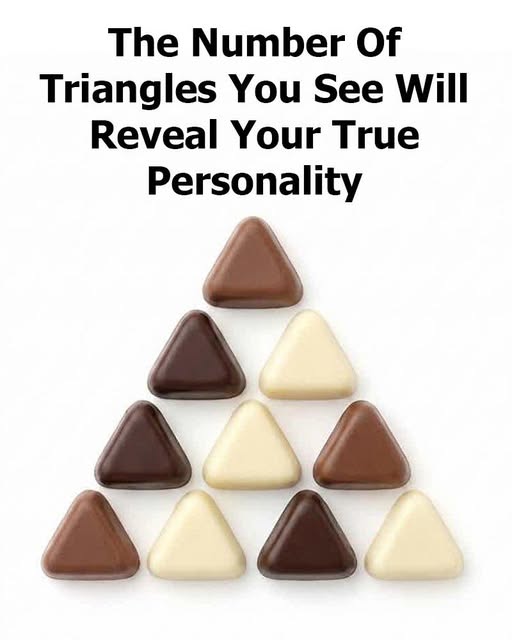
At first glance, the colorful triangle puzzle looks almost too simple to be interesting. A few bold lines, a bright design, and a straightforward question: *How many triangles do you see?* But the moment you begin counting, something surprising happens. The answer doesn’t come easily—and the longer you look, the more uncertain you become.
Some people confidently say there are 9 triangles. Others insist on 13. Many count 16. And then there are those who keep going, discovering 20 or more hidden within the design. How can one image produce so many different answers? The variation isn’t random—it reveals something fascinating about how our minds interpret visual information.
This puzzle taps into a powerful concept in psychology known as the Gestalt principle. In simple terms, the brain prefers to see complete shapes and unified wholes rather than isolated lines and fragments. Instead of analyzing every small piece individually, we naturally group elements together to form patterns. That instinct helps us navigate the world quickly—but it can also trick us when solving visual challenges like this one.
If you counted only a few triangles, you may naturally focus on the most obvious shapes first. This suggests a mindset that values clarity, efficiency, and structure. You see what’s directly in front of you and avoid overcomplicating things. In daily life, that can translate into practical decision-making and strong organizational skills.
If your answer landed somewhere in the middle—around 13 to 16—you likely balance logic with flexibility. You notice the larger shapes, but you also start spotting combinations formed by overlapping lines. This ability to shift perspective is often linked to adaptable thinking and creative problem-solving. You can zoom out for the big picture, then zoom in for hidden details.
And if you found more than 20 triangles, chances are you kept questioning your first impression. You probably rotated the image mentally, traced lines repeatedly, and searched for patterns others might overlook. That kind of persistence and curiosity often connects to imaginative thinking and a willingness to explore unconventional possibilities.
But here’s the most important part: this puzzle isn’t truly about finding the “correct” number. It’s about awareness. The moment you realize there are shapes you initially missed, you experience a small shift in perception. That shift mirrors how we often overlook opportunities, solutions, or perspectives in everyday life—until we slow down and look again.
So before you scroll away, take one more careful look at the image. Count again. You might discover triangles that weren’t visible at first glance. And in that simple act of looking twice, you’ll see the deeper message of the puzzle: perception isn’t fixed. It expands the more attention we give it—and that says more about your mind than any single number ever could.
Leave a Reply