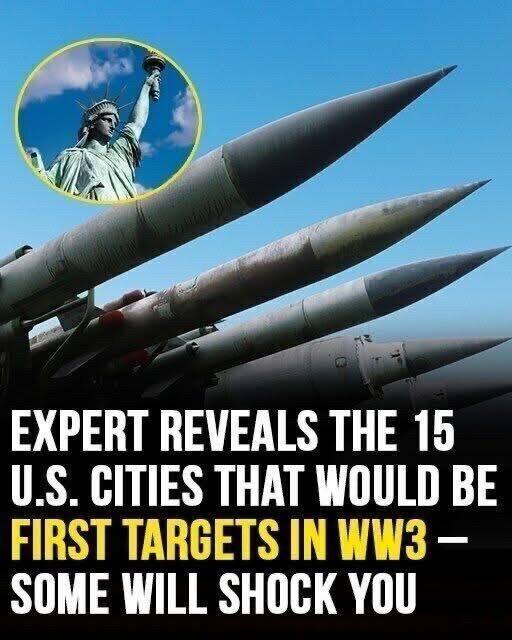
Amid today’s unsettled global climate, anxiety about the possibility of war has quietly taken root in everyday life. What once felt distant and theoretical now appears in bold headlines like *“Expert Reveals the 15 U.S. Cities That Would Be First Targets in WW3 — Some Will Shock You.”* Paired with stark imagery of missiles lined up against a blue sky and the silhouette of the Statue of Liberty, such warnings are designed to provoke a sobering realization: in a modern conflict, even the most powerful nation is not untouchable.
Political instability, military posturing, and sharpened rhetoric between global powers have intensified concerns about long-term stability. While diplomacy and deterrence remain central pillars of international relations, public confidence has been shaken by unpredictable developments and rising tensions across multiple regions. The possibility of miscalculation—especially among nuclear-armed states—keeps worst-case scenarios alive in public discussion.
Defense analysts stress that in a large-scale war, targets would be selected for strategic value rather than sheer population size. Command centers, military infrastructure, nuclear forces, naval fleets, and economic hubs would likely top any adversary’s list. That reality means the risk would extend far beyond just the largest metropolitan areas.
At the top of many expert assessments is **Washington, D.C.**, the political heart of the nation and home to executive and military leadership. Close behind is **New York City**, not only America’s financial powerhouse but also one of its most recognizable global symbols. On the West Coast, **Los Angeles** and **San Francisco** represent economic strength, technological influence, and vital port access.
Major population and transportation hubs such as **Chicago** and energy giant **Houston** are frequently cited due to infrastructure critical to the national economy. Meanwhile, **Seattle** holds aerospace and naval importance, and **San Diego** serves as a cornerstone of U.S. naval power in the Pacific.
Strategic military command locations are equally significant. **Colorado Springs** plays a central role in aerospace defense coordination. **Norfolk** hosts the largest naval base in the world. In the Pacific, **Honolulu** remains critical due to its proximity to Indo-Pacific operations and historic military installations.
Less discussed but equally vital are smaller cities tied to America’s nuclear deterrent. **Cheyenne**, **Great Falls**, and **Minot** are located near intercontinental ballistic missile fields or bomber bases. **Ogden** is closely connected to major Air Force logistics and maintenance facilities. Though smaller in population, their strategic value places them high in theoretical targeting models.
The sobering conclusion from such analyses is not that catastrophe is inevitable, but that modern warfare would focus on disabling command, control, and deterrence capabilities swiftly. The image of missiles poised for launch alongside an American icon is powerful precisely because it highlights what stands at stake—governance, infrastructure, and the systems that sustain daily life.
Yet experts consistently emphasize that deterrence remains strong. Nuclear powers understand that escalation would bring devastating consequences for all sides. While public anxiety reflects genuine global uncertainty, the same strategic calculations that identify potential targets also serve as a reminder of why restraint, diplomacy, and clear communication remain essential to preventing the unthinkable.
Leave a Reply