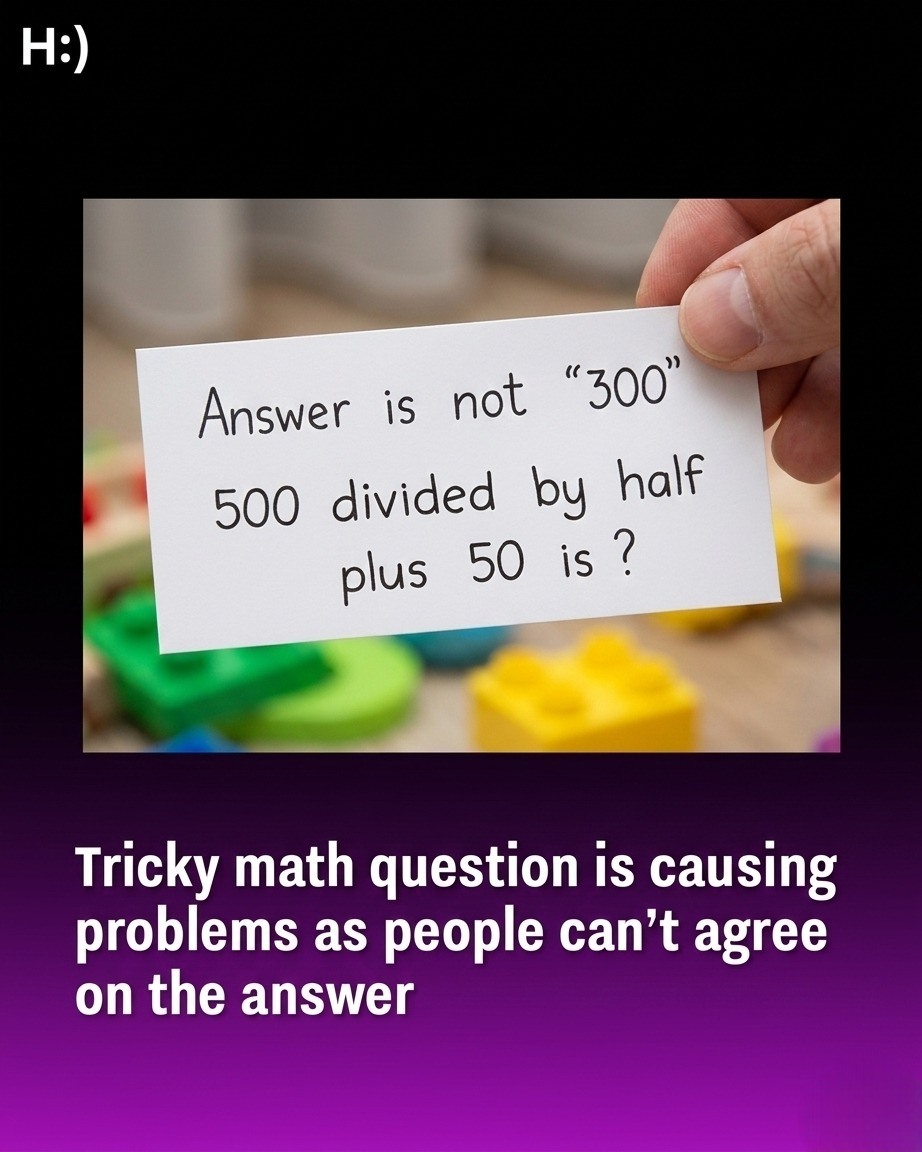
A seemingly simple math puzzle has recently gone viral online, leaving thousands of people debating the correct answer. At first glance, the problem appears incredibly straightforward—something most people believe they can solve instantly. The question reads: “500 divided by half plus 50 is?” Under the image, a small note warns that the answer is not 300, which immediately sparks curiosity and confusion among readers.
Many people instinctively arrive at 300 because they quickly interpret the problem as 500 divided by 2, then plus 50. Following that logic, 500 ÷ 2 equals 250, and adding 50 produces 300. Since this feels like the most natural interpretation, countless readers confidently choose that answer within seconds. However, the warning in the puzzle suggests something is wrong with that assumption, encouraging people to reconsider the wording more carefully.
The real source of confusion lies in the phrase “divided by half.” In everyday conversation, people often think of “half” as simply another way of referring to the number two when discussing division. As a result, many minds automatically translate the phrase into “divide by two.” Mathematically, however, dividing by one-half is completely different from dividing by two.
In mathematics, dividing by a fraction smaller than one actually increases the value instead of reducing it. When you divide a number by 0.5, you are essentially asking how many halves fit inside that number. Because two halves equal one whole, there are twice as many halves as wholes. For that reason, dividing by one-half produces the same result as multiplying by two.
When the equation is interpreted correctly, the calculation becomes much clearer. Instead of dividing 500 by 2, the correct operation is 500 ÷ 0.5. Performing that calculation doubles the number, resulting in 1000 rather than 250. This single detail completely changes the outcome of the puzzle.
Once that step is understood, the final part of the equation is simple. After reaching 1000, the instruction is to add 50. Adding those numbers together produces the final answer of 1050. For many people, this result feels surprising because their brain already committed to the earlier assumption.
Puzzles like this are popular because they rely less on complex mathematics and more on how people interpret language. The actual calculation involves only basic arithmetic, but the wording subtly encourages readers to make a mental shortcut. Psychologists often describe this kind of shortcut as heuristic thinking, which helps the brain make quick decisions but can also lead to mistakes.
In the end, the puzzle succeeds because it combines simplicity with a clever twist. The numbers themselves are easy, yet a small detail in the wording changes the entire calculation. By slowing down and carefully reading the question, the correct answer becomes clear: 1050. More importantly, the puzzle reminds us that sometimes the hardest part of solving a problem isn’t the math—it’s understanding the question itself.
Leave a Reply