Author: Profile 1

  • This Simple Math Puzzle Is Challenging People Online — Can You Solve It?

    This Simple Math Puzzle Is Challenging People Online — Can You Solve It?

    At first glance, it looks easy.

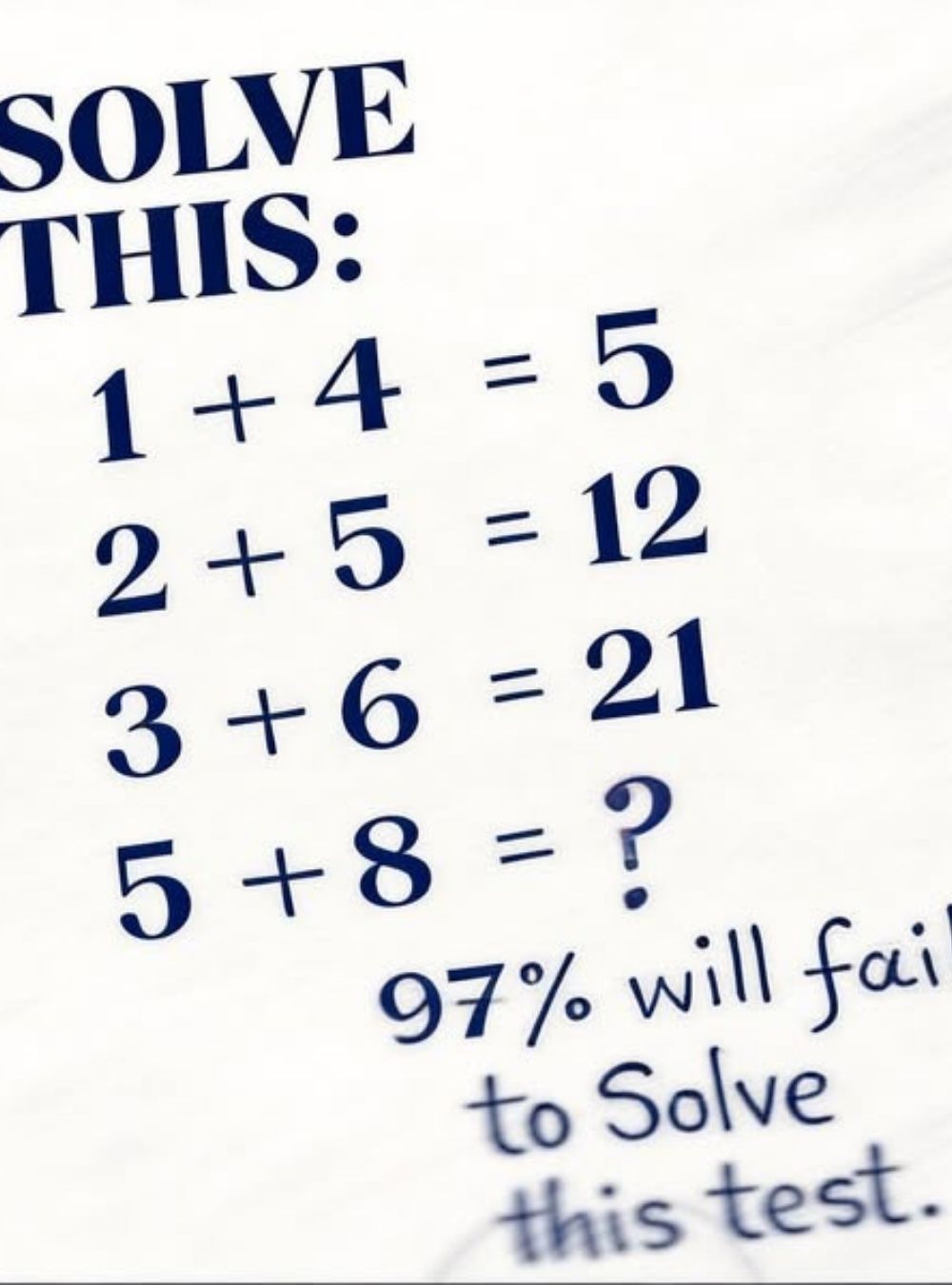
    1 + 4 = 5
    2 + 5 = 12
    3 + 6 = 21
    5 + 8 = ?

    But something doesn’t add up—literally.

    If you try to apply normal arithmetic, the pattern breaks immediately. That’s what makes this puzzle so addictive. It tempts you with simplicity, then forces you to rethink what “addition” really means in this sequence.

    Many people online have proposed different logical explanations.

    One popular solution uses a “multiply and add” approach:

    A × B + A

    Let’s test it:
    1 × 4 + 1 = 5
    2 × 5 + 2 = 12
    3 × 6 + 3 = 21

    So for the final line:

    5 × 8 + 5 = 45

    Using this pattern, the answer would be 45.

    But that’s not the only reasoning people have found.

    Another approach looks at cumulative thinking. Instead of treating each equation separately, it builds on the previous result:

    1 + 4 = 5
    2 + 5 = 7 → 7 + previous result (5) = 12
    3 + 6 = 9 → 9 + previous result (12) = 21
    5 + 8 = 13 → 13 + previous result (21) = 34

    Following this pattern, the answer becomes 34.

    Both solutions are logically consistent—it simply depends on the pattern you choose to recognize.

    And that’s exactly why this puzzle spreads so quickly online.

    It isn’t really about the final number. It’s about pattern recognition, flexible thinking, and the willingness to question assumptions. Math puzzles like this strengthen analytical reasoning because they require you to look beyond the obvious and explore multiple possibilities.

    In the end, whether you arrived at 45, 34, or even another defensible explanation, the real win is the thinking process itself.

    So—what answer did you get?

  • What Chicken Color Really Means — and What It Doesn’t

    What Chicken Color Really Means — and What It Doesn’t

    If you’ve ever stood in the grocery store comparing packages of chicken, you’ve probably noticed the color differences. One tray looks pale pink, almost white. Another has a deeper yellow tint. Even when the cut and price are similar, the contrast can make you pause and wonder: which one is better?

    The truth is, color alone doesn’t determine quality or safety.

    In many cases, the shade of chicken reflects how the bird was raised and, more specifically, what it was fed. Paler chicken is commonly associated with large-scale commercial production. These birds are typically raised indoors on carefully controlled diets designed for consistent growth and efficiency. The result is the light-colored meat many shoppers are used to seeing.

    On the other hand, chicken with a richer yellow tone often reflects diet rather than processing. Feed that includes corn or other naturally pigmented ingredients can influence the color of the skin and fat. The pigments in these feeds are absorbed by the bird and can create a warmer hue. In some cases, chickens that grow more slowly or have more space to move may also develop slightly firmer texture and a fuller flavor, though this varies.

    It’s important to understand that color can sometimes be influenced intentionally. Producers may adjust feed to meet consumer expectations in certain markets where yellow chicken is preferred. This doesn’t automatically make one option superior—it simply reflects market demand.

    When evaluating quality, other factors matter more than color:

    – Clear labeling (organic, pasture-raised, Certified Humane)
    – Freshness and packaging date
    – Texture (firm, not slimy)
    – Smell (neutral, not sour)
    – Proper storage temperature

    Safety is not determined by how yellow or pale the meat appears. Proper handling, refrigeration, and cooking temperature are far more important.
    In the end, there is no single “correct” color that guarantees better chicken. The shade you see is usually linked to feed and farming practices, not freshness or safety. What truly determines quality is how the bird was raised, how it was handled, and what matters most to you as a consumer.

  • A Super Bowl Anthem That Sparked Instant Online Debate

    A Super Bowl Anthem That Sparked Instant Online Debate

    As the stadium settled into silence just moments before kickoff, the atmosphere carried the familiar weight of anticipation. The national anthem is always a defining moment at the Super Bowl—meant to be respectful, emotional, and unifying. This year, the opening notes were delivered with confidence and precision, setting a calm, polished tone for the night ahead.

    Yet almost immediately, attention shifted beyond the field.

    As viewers watched from home, online conversations began forming in real time. The anthem quickly became a talking point across social platforms, discussed just as intensely as the matchup itself. At an event of this magnitude, every note, pause, and vocal inflection is examined closely—and this performance was no exception.

    The setting only heightened expectations. The game took place at Levi’s Stadium in Santa Clara, ahead of Super Bowl LX, with two powerhouse teams facing off. Long before kickoff, discussions about pregame entertainment and production quality had already been circulating, priming audiences to scrutinize every detail.

    Many viewers applauded the singer’s vocal control, calling the rendition smooth, steady, and technically impressive. Others, however, focused less on emotion and more on the broadcast itself, questioning how refined and flawless the vocals sounded during the live transmission. Those observations spread quickly, fueling speculation and debate without any official clarification.

    No statements were made regarding the technical aspects of the performance, and as the game progressed, attention naturally returned to the action on the field. Still, the moment lingered online, serving as yet another reminder of how instantly high-profile performances are analyzed, replayed, and discussed.

    At events like the Super Bowl, even the anthem can become a headline—proving that the opening moments carry as much scrutiny as the final score.

    And the artist whose performance sparked that immediate reaction was Charlie Puth.

  • “Should I do it? Should I grow out my grey?” Valerie asks — and sparks a bigger conversation

    “Should I do it? Should I grow out my grey?” Valerie asks — and sparks a bigger conversation

    A simple question, asked with humor and curiosity, was enough to set the internet buzzing. Known for her familiar brunette look, the actress surprised fans by revealing a bold silver-gray hairstyle—an unexpected transformation that instantly drew attention and admiration.

    The change appeared in early 2026 and felt playful, confident, and intentional. The reveal came through a lighthearted video moment, where the new look was shown not as a dramatic statement, but as a fun experiment. The silver tones were luminous and striking, marking what many viewers quickly described as a “silver era” moment.

    Behind the scenes, the transformation was guided by a celebrity hairstylist known for dramatic, high-impact looks. Whether the style involved wigs or temporary techniques remained secondary to the reaction it sparked: excitement, curiosity, and a flood of opinions from fans who saw the look as both daring and empowering.

    This wasn’t the first time she had played with reinvention. In recent years, she’s openly embraced experimentation—trying lighter shades, dramatic cuts, and even laughing at styling missteps. Each change came with honesty, often paired with reflection about how appearance connects to self-image.

    What made this moment different was the question behind it. Growing out gray hair wasn’t framed as a trend or a makeover—it was framed as a choice. A conversation about aging, authenticity, and the freedom to redefine beauty on one’s own terms.

    She shared thoughtful insights about identity and self-worth, acknowledging how years of pleasing others can distance a person from their true self. For her, hair color became symbolic. The brunette shade she’s long been associated with represents a younger version of herself—one she still wants to honor and protect. The gray, meanwhile, represents something new: self-acceptance without apology.Her public journey has always mirrored that evolution. From iconic long hair in the 1970s, to layered and feathered styles in the ’80s, to sleeker looks in later decades, she’s continually adapted while staying unmistakably herself. Even moments that didn’t go as planned became chances for humor and connection.

    Now, in 2026, the idea of embracing gray feels less about hair and more about choice. Whether she commits fully or not, the message is clear: transformation doesn’t require permission.

    And the woman inviting everyone into that conversation is Valerie Bertinelli.

  • A Heartbreaking Farewell to a Former Child Star Whose Smile Defined a Generation

    A Heartbreaking Farewell to a Former Child Star Whose Smile Defined a Generation

    With heavy hearts, family members have confirmed the passing of a former child actor best remembered for his role in the 2006 family film How to Eat Fried Worms. He was just 33 years old. The news has stunned fans who grew up watching him on screen and remembered his youthful energy and unmistakable presence.

    He passed away on Sunday, February 8, in Tulsa, Oklahoma. His mother shared the devastating update publicly, explaining that the family is still awaiting official autopsy results to determine the exact cause of death. The sudden nature of his passing has left loved ones searching for answers and processing a loss that feels far too soon.

    Born in Austin, Texas, he discovered his passion for performance early in life. As a child, he appeared in local theater productions including Aladdin, The Wizard of Oz, Annie, and Grease. Those early roles revealed a natural charisma and stage confidence that quickly set him apart.

    At only 10 years old, he achieved a significant milestone by touring nationally with Barney’s Colorful World. That experience opened doors in television and film, placing him on a path toward broader recognition.

    His breakout moment came in How to Eat Fried Worms, where he portrayed “Plug,” a character that helped define the film’s ensemble dynamic. The cast received a Young Artist Award, cementing the movie as a memorable part of mid-2000s family entertainment. For many fans, his performance became part of their childhood memories.

    In recent years, he had stepped away from the spotlight and was living in Oklahoma. According to his family, he had been focused on rebuilding his life and was committed to maintaining sobriety—an accomplishment they say meant a great deal to him. Those close to him described him as resilient and determined, someone who worked hard to create a healthier future for himself.His mother shared that shortly before his passing, he sought medical care for severe pain and was diagnosed with shingles. She believes possible complications may have contributed to his sudden death, though official confirmation is still pending.

    Now, as tributes pour in, many remember not just the child actor they once watched on screen, but the person he became—someone striving for stability, growth, and peace. His story is a reminder of how deeply childhood performances can stay with audiences, long after the credits roll.

  • I Always Wondered What That Was… You Might Have This Skin Condition

    I Always Wondered What That Was… You Might Have This Skin Condition

    Those tiny, intensely itchy blisters that seem to appear out of nowhere—especially when the seasons change—leave many people confused. They’re small, often clustered, and can feel like they’re buried deep beneath the skin. If that sounds familiar, you might be dealing with a specific form of eczema that tends to show up on the hands and feet.

    Dyshidrotic eczema, also known as pompholyx, is a recurring skin condition characterized by small, fluid-filled blisters. These typically form along the sides of the fingers, on the palms, or on the soles of the feet. While manageable, the condition can be uncomfortable and disruptive—particularly when flare-ups make simple daily tasks painful.

    Eczema itself is a broad term covering several inflammatory skin conditions. Common symptoms across types include redness, dryness, irritation, and small bumps that may itch or burn. It is not contagious, but it can be influenced by a mix of genetic factors, environmental exposure, allergies, and emotional stress.

    What makes dyshidrotic eczema distinct is the nature of its blisters. They often feel deep-seated and may cause intense itching or a burning sensation. As they heal, the skin may peel, crack, or become temporarily sensitive. For some individuals, flare-ups occur seasonally—especially in spring or during periods of high humidity.

    Although the exact cause isn’t fully understood, several common triggers have been identified. These may include:

    • Seasonal allergens
    • Excess moisture or sweating
    • Contact with irritants such as detergents or metals
    • Emotional stress
    • Underlying skin sensitivities

    Because triggers vary from person to person, many individuals benefit from tracking patterns in their routines and environments to better understand what worsens their symptoms.

    Treatment typically focuses on relieving discomfort and protecting the skin barrier. Moisturizers designed for sensitive skin, cool compresses, and guidance from a healthcare professional can help reduce irritation during flare-ups. In some cases, prescription treatments may be recommended to manage inflammation.

    For those experiencing this condition, consistency is key. Maintaining a gentle skincare routine and minimizing exposure to known triggers can help reduce recurrence and improve overall comfort.

    If you’ve ever noticed those stubborn little blisters and wondered what they were, this explanation may finally connect the dots.

  • Never Flush the Toilet After Urinating?

    Never Flush the Toilet After Urinating?

    At first glance, the image feels almost shocking. A finger hovering over the flush button, paired with a bold warning: “Never flush the toilet after urinating. It’s a big mistake.” It sounds extreme, even unhygienic. And yet, messages like this keep circulating for a reason—they spark curiosity, debate, and reflection about habits we never question.

    So what’s really behind this claim?

    The phrase often associated with this mindset is simple: “If it’s yellow, let it mellow.” While it may sound informal, the principle behind it is rooted in conservation. Urine is mostly water and, in a clean toilet, doesn’t pose an immediate health risk when left briefly. For many eco-conscious households, especially during the night or when living alone, flushing less frequently has become a conscious choice.

    There’s also another layer to this message: awareness. The image isn’t just telling you what to do—it’s interrupting autopilot. Most of us flush without thinking. The warning forces a pause, encouraging people to question habits they’ve repeated for years without considering their impact.

    For decades, flushing after every use has been treated as an unquestionable rule of hygiene. But in recent years, discussions around water consumption, sustainability, and everyday waste have brought even the smallest household habits under the microscope. The flush button, once pressed automatically, is now being reexamined.

    A single toilet flush uses a surprising amount of clean drinking water. Multiply that by several times a day, by every member of a household, and the numbers grow fast. In regions facing water shortages or rising utility costs, skipping unnecessary flushes—especially after urinating—has been proposed as a simple way to reduce water waste. The idea isn’t about neglect or poor hygiene, but about intentional use.

    That said, context matters. Not flushing may be reasonable in private homes with proper ventilation and regular cleaning routines, but it’s not suitable everywhere. Shared bathrooms, public spaces, or households with multiple users require stricter hygiene standards. Odors, bacteria buildup, and general comfort are valid concerns and shouldn’t be ignored.

    The image doesn’t mean flushing is wrong. It suggests that automatic flushing might be. It’s a reminder that even the smallest daily actions carry consequences—financial, environmental, and practical.

    In the end, the message isn’t really about the toilet at all.
    It’s about mindfulness.

    About choosing when something is necessary—and when it’s just habit.

  • The Hidden Meaning of Thumb Rings Explained in Depth: How One Small Piece of Jewelry Reflects Power, Identity, Confidence, History, Rebellion, and Self-Expression for Women and Men Across Cultures and Time

    The Hidden Meaning of Thumb Rings Explained in Depth: How One Small Piece of Jewelry Reflects Power, Identity, Confidence, History, Rebellion, and Self-Expression for Women and Men Across Cultures and Time

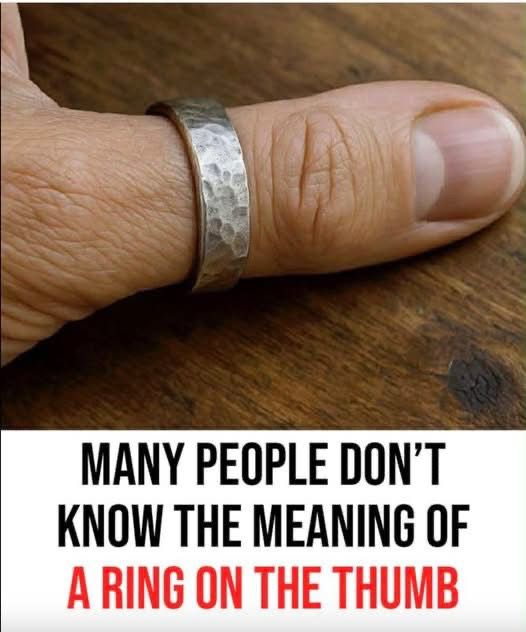
    The thumb is anatomically unique. It stands apart from the other fingers, enabling grip, strength, and dexterity. Without it, the human hand loses much of its power and functionality. Symbolically, this physical reality has long translated into psychological and cultural meaning. The thumb represents willpower, autonomy, control, and personal agency. When someone chooses to wear a ring on this finger, the choice is rarely accidental, even if the wearer is not consciously aware of the deeper symbolism behind it.

    Understanding the meaning of thumb rings requires looking at history, psychology, gender norms, cultural shifts, and modern self-expression. While the symbolism differs slightly for women and men, at its core, a thumb ring almost always communicates one thing: a strong sense of self.

    Why the Thumb Is Symbolically Different From Other Fingers

    In symbolism and body language, the thumb is associated with strength, decision-making, and authority. Ancient philosophers and mystics viewed the thumb as an extension of the will. In palmistry, the thumb is linked to logic, determination, and independence. It is the finger that allows the hand to close into a fist or grasp an object firmly, reinforcing its association with power and control.

    Unlike the ring finger, which is traditionally associated with romance, union, and commitment, the thumb is about the self rather than the partnership. A ring on the thumb does not suggest belonging to someone else. Instead, it often signals ownership of oneself.

    Because the thumb is also visually prominent and unconventional as a place for jewelry, a ring worn there naturally draws attention. This makes it an ideal choice for individuals who are comfortable being noticed, standing out, or subtly challenging expectations.

    The Psychological Meaning of Wearing a Thumb Ring

    From a psychological perspective, thumb rings are often associated with confidence and self-assurance. People who choose to wear rings on the thumb tend to be comfortable asserting their identity and making independent choices. This does not necessarily mean they are loud or aggressive; rather, it suggests an internal sense of certainty.

    Wearing a thumb ring can also function as a form of self-anchoring. Just as some people wear meaningful jewelry to remind themselves of personal values or milestones, a thumb ring can symbolize boundaries, autonomy, or personal strength. The physical sensation of the ring on such an active finger reinforces awareness of the self in daily actions.

    In many cases, the decision to wear a thumb ring coincides with periods of personal growth, transition, or empowerment. It may appear after a breakup, during a career shift, or at a time when the wearer is redefining their identity outside of traditional roles.

    What Thumb Rings Represent for Women

    For women, thumb rings have carried particularly powerful and sometimes controversial meanings, largely because they challenge long-standing expectations around femininity, compliance, and appearance.

    Historically, women’s jewelry was often designed to signal availability, status, or alignment with social norms. Rings on the ring finger indicated marriage or engagement, while delicate designs reinforced ideals of softness and decorum. A thumb ring, by contrast, disrupts this narrative.

    For many women, wearing a thumb ring symbolizes independence and self-determination. It communicates that the wearer is not primarily defined by relationships, societal approval, or traditional roles. Instead, it highlights personal agency and confidence.

    During the late 20th century, particularly in the 1990s and early 2000s, thumb rings became associated with feminist expression and, in some contexts, LGBTQ+ identity. While not universally understood as such, the placement served as a subtle signal of resistance to heteronormative and patriarchal expectations. For women who felt constrained by social norms, the thumb ring offered a quiet but visible declaration of autonomy.

    Even today, many women choose thumb rings to express boldness, creativity, and individuality. The style of the ring itself often reinforces the message. Chunky, minimalist, or unconventional designs are common, reflecting strength rather than ornamentation. For some, the thumb ring becomes a signature piece, something that feels essential rather than decorative.

    Importantly, the meaning does not have to be political or sexual to be significant. For many women, a thumb ring simply represents comfort in their own skin and a refusal to shrink themselves to fit expectations.

    The Emotional Dimension for Women

    Emotionally, women who wear thumb rings often describe a sense of grounding or empowerment. Because the thumb is so active, the ring becomes part of everyday movement, reinforcing presence and awareness. This can subtly boost confidence, especially in environments where women are expected to be accommodating or invisible.

    The thumb ring can also act as a boundary marker. It is a visual reminder of self-ownership, signaling that the wearer prioritizes personal values and limits. In this sense, it becomes less about fashion and more about identity reinforcement.

    What Thumb Rings Represent for Men

    For men, the symbolism of thumb rings is deeply rooted in history and tradition. In ancient civilizations, thumb rings were often worn by archers, warriors, and leaders. In Rome, thumb rings symbolized wealth, power, and authority. They were sometimes used as signet rings, allowing men to stamp documents with their personal seal.

    In parts of Asia, thumb rings were worn by noblemen and military figures, often made from jade, gold, or ivory. These rings served both functional and symbolic purposes, protecting the thumb during archery while also signaling rank and masculinity.

    Because of this history, thumb rings on men have long been associated with strength, dominance, and influence. Even today, men who wear thumb rings often project confidence and nonconformity. The choice suggests that the wearer is not afraid to deviate from conventional styles or expectations.

    Modern interpretations of male thumb rings frequently emphasize individuality and rebellion. In cultures where men’s jewelry is still somewhat restricted, a thumb ring stands out as a deliberate choice. It communicates self-expression and comfort with visibility.

    Masculinity and Sexual Confidence

    In some interpretations, especially in contemporary contexts, a thumb ring on a man can also suggest sexual confidence. This does not imply promiscuity, but rather comfort with one’s desires, body, and presence. The thumb’s association with willpower and assertion translates symbolically into confidence in intimate and social settings.

    Whether worn on the left or right hand, the ring may add an element of mystery. Because thumb rings are less common, they invite curiosity and interpretation, allowing the wearer to project intrigue without saying a word.

    Left Hand vs. Right Hand: Does Placement Matter?

    In symbolic traditions, the left hand is often associated with internal states, intuition, and personal identity, while the right hand is linked to action, logic, and outward expression. Applying this framework, a thumb ring on the left hand may suggest inner confidence, self-awareness, or emotional autonomy.

    A thumb ring on the right hand, by contrast, may emphasize outward independence, assertiveness, and engagement with the world. For women, right-hand thumb rings have historically been more visible as statements of nonconformity. For men, right-hand thumb rings often highlight leadership or decisiveness.

    That said, modern fashion has blurred many of these distinctions. Today, placement often reflects comfort, habit, or personal preference more than strict symbolism. Still, some wearers consciously choose one hand over the other to align with personal meaning.

    Modern Fashion and Individual Expression

    In contemporary society, thumb rings occupy an interesting space between symbolism and style. While not everyone who wears one does so intentionally for its meaning, the choice still carries cultural weight. Fashion trends often revive symbolic gestures long after their origins are forgotten, allowing individuals to tap into deeper meanings intuitively.

    Designers have increasingly embraced thumb rings as statements of modern identity. Oversized bands, minimalist metals, and unisex designs reinforce the idea that thumb rings transcend traditional gender boundaries. This universality reflects a broader cultural shift toward fluidity and self-definition.

    Why Thumb Rings Continue to Fascinate

    The enduring appeal of thumb rings lies in their ambiguity. They are visible but not explicit, meaningful but not rigid. They allow wearers to express strength, independence, and confidence without conforming to predefined narratives.

    In a world where identity is increasingly self-curated rather than assigned, thumb rings offer a small but powerful way to assert individuality. They signal that the wearer is comfortable standing apart, making choices that feel authentic rather than expected.

    Final Reflection

    The hidden meaning of thumb rings is not confined to a single interpretation. For women, they often symbolize independence, empowerment, and resistance to limiting norms. For men, they reflect strength, authority, and individuality rooted in historical tradition. Across genders, they communicate confidence, self-ownership, and a willingness to be seen as one truly is.

    Ultimately, a thumb ring is less about what others think it means and more about what it represents to the person wearing it. Whether chosen consciously or instinctively, it serves as a quiet declaration of autonomy in a culture that often pressures people to conform. In that sense, the thumb ring remains one of the most understated yet powerful symbols of personal identity and self-expression.

  • My Date Paid for Dinner — But What Happened Next Left Me Shocked and Forced Me to Rethink Charm, Generosity, and the Hidden Expectations That Can Turn a Seemingly Perfect Evening Into an Unsettling Lesson About Entitlement, Control, and Paying Attention to Red Flags

    My Date Paid for Dinner — But What Happened Next Left Me Shocked and Forced Me to Rethink Charm, Generosity, and the Hidden Expectations That Can Turn a Seemingly Perfect Evening Into an Unsettling Lesson About Entitlement, Control, and Paying Attention to Red Flags

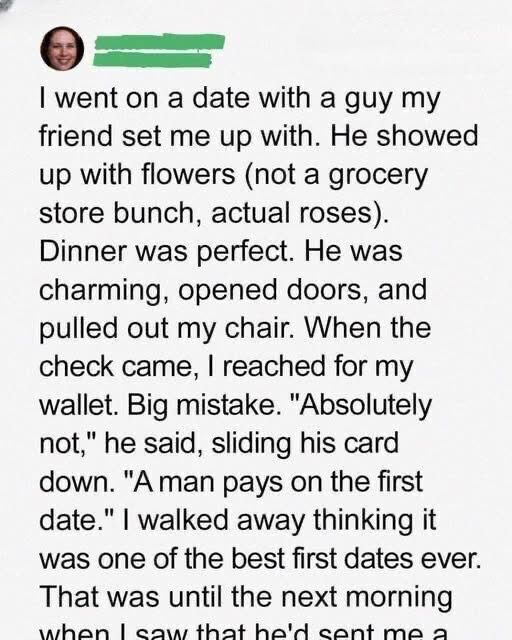
    When my best friend Mia suggested setting me up with her boyfriend’s friend, my first instinct was to say no. Blind dates had never gone particularly well for me, and I’d learned to trust my hesitation. Still, Mia was persistent in that reassuring way only a close friend can be. She described him as kind, dependable, and “a little old-fashioned, but in a good way.” His name was Eric, and she seemed genuinely confident that we’d get along.

    From the beginning, Eric seemed different from the usual dating app conversations I was used to. He didn’t send one-word replies or late-night “hey” messages. He wrote thoughtfully, asked real questions about my job, my hobbies, my family. He remembered details and referenced them later. It felt refreshing, almost reassuring, like I was finally talking to someone who knew how to communicate like an adult.

    After about a week of messaging, he suggested we meet for dinner. He picked a well-known Italian restaurant downtown—nice, but not over-the-top. I appreciated that he asked what nights worked for me and didn’t pressure me into anything spontaneous. Everything about him felt… safe.

    The night of the date, he arrived early. That alone set a positive tone. When I walked in, he stood up immediately, smiling, holding a small bouquet of roses. It was sweet, if a little formal, but I chalked it up to nerves or his “old-fashioned” side. He pulled out my chair, complimented my dress, and handed me a small keychain engraved with my initial. I remember thinking it was a bit much for a first date, but also oddly thoughtful.

    Dinner itself went smoothly. Conversation flowed without effort. We talked about travel, work, embarrassing dating stories, and favorite foods. He listened attentively, nodded, laughed at the right moments. Nothing felt forced. I found myself relaxing, thinking maybe Mia had been right.

    When the check arrived, I reached for my wallet out of habit. Eric gently waved me off.

    “A man pays on the first date,” he said with a confident smile.

    It wasn’t something I expected, but it didn’t feel aggressive or uncomfortable in the moment. I thanked him, and we continued chatting. He walked me to my car afterward, waited until I got inside, and didn’t try anything inappropriate. I drove home thinking it had been a genuinely pleasant evening.

    That’s why what happened next felt so jarring.

    The following morning, I woke up expecting a simple text—something like “I had a great time” or “Hope you got home safe.” Instead, I saw an email notification from Eric with the subject line: “Invoice for Last Night.”

    At first, I laughed. I genuinely assumed it was a joke, maybe some awkward humor that didn’t quite land. Curious, I opened it.

    It wasn’t a joke.

    The document was formatted like a real invoice. Line by line, it listed charges: dinner, flowers, the engraved keychain. Then, bizarrely, a line labeled “emotional labor.” Each item had a price attached. At the bottom, there were repayment instructions and a note stating that failure to comply could result in “Chris being informed”—Chris being Mia’s boyfriend.

    My stomach dropped.

    I reread the email several times, hoping I was misunderstanding something. I wasn’t. The tone wasn’t playful or ironic. It was transactional, almost threatening. The same man who had insisted on paying now seemed to believe that his generosity had created a debt I owed him.

    I immediately texted Mia.

    Her response came within seconds: “Oh my god. He’s insane. Don’t respond.”

    She looped Chris in, and together they decided to confront the situation in their own way. Chris sent Eric a mock invoice listing penalties for making someone uncomfortable, behaving entitled, and misunderstanding basic decency. It was sarcastic, pointed, and honestly a little cathartic.

    Eric did not take it well.

    His messages quickly shifted from defensive explanations to anger, then to self-pity. He accused us of misunderstanding him, of humiliating him, of being ungrateful. I didn’t respond. I didn’t owe him anything—financially or emotionally.

    Mia and Chris cut him off completely.

    In the days that followed, I replayed the evening in my mind. The roses. The gift. The insistence on paying. What I initially interpreted as politeness now felt different, almost calculated. It wasn’t generosity—it was leverage.

    That experience taught me something important: real kindness doesn’t come with an invoice. Genuine generosity isn’t something you collect on later. And charm, when paired with entitlement, isn’t charm at all.

    The night had started like a romantic comedy. It ended as a lesson.

    I didn’t pay him back the way he expected. But I did pay attention. And that turned out to be far more valuable than any dinner bill ever could be.

    After the shock wore off, what lingered wasn’t anger so much as confusion. I kept asking myself how I hadn’t seen it sooner. How someone who seemed so considerate, so intentional in his words and gestures, could pivot so quickly into something that felt manipulative and unsettling. It forced me to confront an uncomfortable truth: sometimes red flags don’t wave loudly. Sometimes they arrive wrapped in politeness, flowers, and full sentences.

    In the weeks after, I talked it through with Mia more times than I could count. Each conversation peeled back another layer of the experience. We analyzed every detail, not in a self-blaming way, but in an effort to understand how easily expectations can be hidden beneath charm. Mia admitted she’d seen flashes of odd behavior from Eric before, small comments about “owing” people or keeping score in relationships, but nothing that had raised alarms until now.

    Chris, for his part, was furious. Not just on my behalf, but because Eric’s behavior revealed a side of him that felt fundamentally unsafe. The idea that someone could feel entitled to another person’s time, emotions, or body simply because money was spent disturbed him deeply. He said something that stuck with me: “Anyone who turns generosity into a contract was never being generous in the first place.”

    That sentence replayed in my head often.

    As time passed, I noticed how the experience subtly reshaped my approach to dating. I became more attentive, not just to how someone treated me, but to why they did certain things. Did they listen because they cared, or because they were collecting information? Did they give because they wanted to, or because they expected a return? These questions weren’t meant to foster suspicion, but awareness.

    I also realized how often women are conditioned to excuse discomfort. How frequently we’re taught to smooth things over, to laugh things off, to give the benefit of the doubt even when our instincts whisper otherwise. That morning, when I opened Eric’s email, my first reaction had been to laugh. To assume I was misreading it. To downplay my own unease. That instinct—to minimize—was as ingrained as it was dangerous.

    There was also a strange grief attached to it all. Not for Eric, but for the version of the evening I thought I’d experienced. I’d genuinely enjoyed the dinner. I’d felt hopeful, maybe even a little excited. Realizing that those moments had been tethered to an unspoken expectation felt like discovering a crack running through a memory you thought was solid.

    Yet, there was empowerment too.

    For the first time, I didn’t explain myself. I didn’t justify my reaction. I didn’t negotiate. I simply disengaged. That, in itself, felt like growth.

    Weeks later, Mia mentioned in passing that Eric had tried reaching out to mutual acquaintances, framing the situation as a misunderstanding. According to him, it had all been a “social experiment” or “a joke taken the wrong way.” No apology. No acknowledgment of discomfort. Just reframing. That told me everything I needed to know.

    I never responded. Silence, I learned, is sometimes the clearest boundary.

    Looking back now, the story has become something I share cautiously, not as a warning meant to instill fear, but as a reminder of discernment. It’s easy to romanticize gestures without questioning intent. It’s easy to confuse effort with entitlement, tradition with control. But true respect never keeps a ledger.

    The dinner bill was paid that night. But the cost of the lesson lingered far longer—and shaped me far more deeply.

    And if there’s one thing I carry forward, it’s this: attention is the most powerful currency we have. Where we place it determines not just who we invite into our lives, but who we protect ourselves from.

    That realization, earned through an unexpected invoice and an uncomfortable awakening, was worth far more than any meal ever could be.

  • Here’s the Surprising Truth Behind the Lines on Your Bath Towels — What These Seemingly Simple Patterns Actually Mean, Why They’re There, and How Understanding Them Can Help You Choose Better Towels and Care for Them Properly.

    Here’s the Surprising Truth Behind the Lines on Your Bath Towels — What These Seemingly Simple Patterns Actually Mean, Why They’re There, and How Understanding Them Can Help You Choose Better Towels and Care for Them Properly.

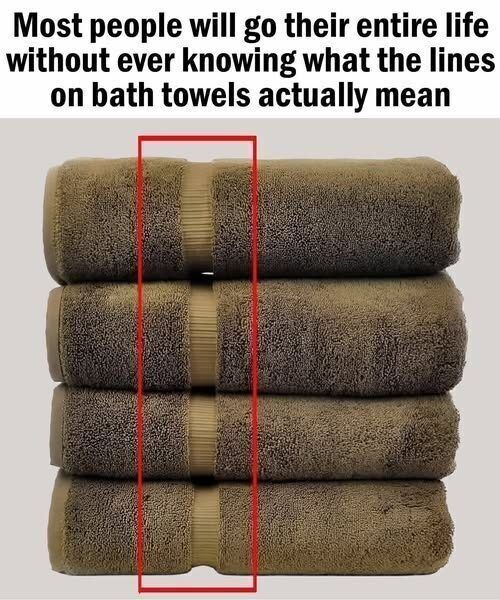
    Bath towels often appear simple at first glance, but a closer look reveals design elements that serve purposes beyond aesthetics. One of the most recognizable of these features is the set of raised or indented lines, ridges, or borders near the edges. While many people treat these as merely decorative, they actually reveal a great deal about the way towels are designed, constructed, and expected to perform over time. Understanding the importance of these lines helps consumers make more informed choices, especially because something as ordinary as a towel is used daily yet rarely examined in detail. The discussion of these subtle features opens a window into textile craftsmanship, highlighting how small design choices contribute to functionality, longevity, and user experience. Overall, these border lines are not random embellishments—they are intentional, practical elements with lasting value for durability, organization, aesthetics, and performance.

    These border lines, often known in textile terminology as dobby or dobie borders, are created through a distinct weaving technique that differs from the rest of the towel. Whereas the absorbent portion of towels is typically constructed using looped cotton yarn designed for maximum moisture absorption, the border area uses a flatter, tighter weave that sacrifices fluffiness for structure. This difference in weave creates a border that is more resistant to stretching, fraying, and deforming—three common issues that occur when towels are frequently washed, dried, pulled, and folded. The stability provided by this tighter woven edge acts like a frame, helping the towel maintain its shape over a long period of use. It also gives the entire product a clear and finished appearance, enhancing the sense of quality. Through this carefully engineered design, manufacturers ensure that towels remain visually appealing while holding up against repeated handling and cleaning cycles.

    The border lines also add functional value when it comes to organization and use, particularly in households or environments where towels must be consistently folded or displayed. Because the lines create a visual division between the edges and the main absorbent field, they serve as natural guides that make folding easier and more uniform. Whether someone is aiming for the crisp, spa-like appearance favored in hotels or simply trying to keep a linen closet tidy, these lines help ensure that towels align neatly and stack evenly. This detail becomes especially useful when multiple towels are kept together, as the defined edges help prevent bunching and irregular folds. Additionally, these border designs can help differentiate one towel from another, which is particularly helpful in shared living spaces or households with several members. Even slight variations in the border pattern can make it easy to keep track of whose towel is whose, reducing confusion and enhancing both organization and hygiene.

    Beyond structure and usability, the design of towel borders can also indicate product quality and play a role in determining price. Higher-end towels often feature more complex, decorative dobby borders that demonstrate a manufacturer’s attention to detail and craftsmanship. These patterns may include geometric motifs, flourishes, textured details, or even brand-specific designs that signal prestige. By contrast, lower-priced towels may include only minimal borders or sometimes lack them entirely, relying solely on simple stitching to maintain edge integrity. Consumers browsing for towels may not always consciously analyze these borders, but the intricacy, symmetry, and precision of the weaving often correlate with how much time, effort, and skill went into producing the towel. In some cases, these patterns may be designed to complement bathroom décor or to match coordinated towel sets. In other cases, the inclusion of logos or initials adds a personalized or luxurious touch. Thus, the presence and style of towel lines can serve as a subtle but reliable indicator of overall quality.