Category: Uncategorized

  • Quiet Lesson High Above Clouds Changed My Entire View Of Empathy

    Quiet Lesson High Above Clouds Changed My Entire View Of Empathy

    I boarded the flight worn down and closed in on myself, carrying a quiet irritation I didn’t bother to examine. The cabin felt too loud, the aisle too narrow, the delay too long. I wanted the world to recede until landing. In that small, inward place, my own comfort felt urgent and everything else felt secondary.

    A few rows back, a pregnant woman settled into her seat. She moved carefully, without complaint, accepting the tight space and the constant jostling as if it were simply part of the day. She didn’t ask for favors or draw attention to herself. She just endured, calmly. Watching her, something loosened in me. My impatience didn’t vanish, but it lost its authority. I realized how narrow my focus had become—and how easily I had forgotten that everyone around me was carrying something of their own.

    By the time we landed, the lesson had clarified itself. Empathy doesn’t usually arrive with grand gestures. It shows up as awareness—seeing the other person, adjusting a little, choosing restraint over entitlement. It asks for steadiness more than spectacle. I understood that my minor preferences didn’t outweigh another person’s strain, and that choosing patience was not a loss of self, but a correction of it.

    Since then, I try to pause before retreating into myself. I look up. I make room. I keep my voice softer and my expectations lighter. These are small things, but they matter. They shape the air we share.

    Kindness doesn’t need to announce itself. It grows in attention and intention, in the decision to meet the world with awareness rather than urgency. And when I choose that posture—even imperfectly—I find that it changes not only how I move through my day, but who I am while moving through it.

  • The Mystery Behind the Blue-and-Yellow Can: The Story of WD-40

    The Mystery Behind the Blue-and-Yellow Can: The Story of WD-40

    WD-40 is a familiar product in many homes, commonly used to loosen stuck parts or stop squeaks. While most people recognize the name, few know it began as a specialized chemical created for military use rather than everyday repairs.

    In 1953, scientists at the Rocket Chemical Company in San Diego were working on a solution to protect Atlas missiles from rust. The missile casings were extremely thin and vulnerable to moisture while stored, making corrosion a serious risk. Chemist Norm Larsen led the project, which focused on developing a compound that could repel water and prevent metal damage.

    The name WD-40 stands for “Water Displacement, 40th formula.” It reflects the fact that the first 39 attempts failed to meet the necessary standards before the team finally achieved a working solution on their fortieth try.

    Originally intended for aerospace protection, the product gained wider attention when employees began taking it home to use on household problems. The company soon recognized its commercial potential and released it for public sale.

    Today, WD-40 is used for a wide range of everyday tasks, from freeing rusted bolts to cleaning tools. Its name serves as a reminder that the product’s success came only after repeated failure and persistent experimentation.

  • What Happens When You Cross Paths With a Black Cat

    What Happens When You Cross Paths With a Black Cat

    Black cats have held a unique place in human culture for centuries, often surrounded by strong emotional reactions ranging from admiration to fear. Their dark coats and quiet movements made them stand out in early societies that explained unfamiliar things through stories and symbolism. Over time, these interpretations shaped lasting superstitions.

    In parts of medieval Europe, black cats became linked to witchcraft. Many people believed they were connected to supernatural forces or could bring bad luck if they crossed someone’s path. These ideas spread widely and became part of folklore, even though they had no factual basis. The influence of these beliefs continues today, with black cats still being adopted less frequently from shelters compared to other cats.

    In reality, when a black cat approaches a person or enters a home, the reason is almost always practical. Cats seek food, warmth, safety, and calm environments. Their behavior is driven by curiosity and survival instincts, not symbolism. A wandering cat is typically responding to scent, shelter, or previous positive human interaction.

    Not all cultures viewed black cats negatively. In ancient Egypt, cats were highly valued and protected because they helped control pests and were associated with household safety. Some societies linked darker-colored cats with strength, intuition, and protection rather than misfortune. These positive associations often came from the real benefits cats provided in daily life.

    Cats also developed a reputation for independence. Unlike animals that were bred to follow commands, cats choose when to engage with people. This made them symbols of autonomy and mutual respect in many traditions.

    The connection between cats and good fortune originally came from practical outcomes: homes with cats had fewer rodents, better food storage, and reduced disease risk. Over time, these advantages became symbolic, leading people to associate cats with prosperity and balance.

    Modern perspectives increasingly reject old superstitions. Today, black cats are often appreciated for their elegance, intelligence, and strong personalities. Their presence is understood as no different from that of any other cat.

    Ultimately, black cats carry no hidden meaning beyond what humans assign to them. Encounters with them are ordinary animal interactions shaped by instinct and environment. The long history of superstition says more about human fear of the unknown than about the animals themselves.

    A black cat crossing your path or entering your home is not a sign of luck or misfortune — it is simply a living creature responding to its surroundings, deserving the same care and respect as any other.

  • I Was Suddenly Woken Up By My Husband Laughing In His Sleep—Then I Found His Secret Life: A Midnight Sound That Unraveled Hidden Truths, Shattered Trust, Exposed Double Identities, and Pulled Me Into a Web of Lies, Late-Night Messages, and Discoveries That Changed My Marriage, My Reality, and Everything Forever

    I Was Suddenly Woken Up By My Husband Laughing In His Sleep—Then I Found His Secret Life: A Midnight Sound That Unraveled Hidden Truths, Shattered Trust, Exposed Double Identities, and Pulled Me Into a Web of Lies, Late-Night Messages, and Discoveries That Changed My Marriage, My Reality, and Everything Forever

    I woke up to strange sounds in the dark—low humming at first, almost like a lullaby whispered through clenched teeth. My eyes fluttered open, disoriented, still half lost in sleep. Then the humming turned into giggling. Soft at first. Then louder. Unfamiliar. Wrong.

    His arms flapped awkwardly against the blankets, as if he were struggling to swim through invisible water. His head jerked slightly from side to side. His lips moved, forming broken syllables that made no sense. His eyes were rolled back beneath twitching lids. For a split second my mind refused to process what I was seeing. This wasn’t a dream. This was my husband—my calm, quiet, controlled husband—convulsing gently beside me like a stranger wearing his face.

    I screamed his name.

    He didn’t respond.

    Panic ripped through me. My hands shook as I grabbed my phone from the nightstand and dialed 911 with fingers that barely obeyed me. My voice broke as I explained what was happening, that my husband was unresponsive, making strange sounds, that I didn’t know what to do. The dispatcher tried to keep me calm, but time collapsed into a blur of fear and noise.

    By the time the paramedics arrived, Sayed had gone still. Too still.

    They loaded him onto a stretcher under the harsh glare of our hallway light. His face looked peaceful, as if nothing violent had just passed through his body. That terrified me more than the seizure itself. I rode in the ambulance beside him, clutching his cold hand while machines beeped around us. I kept whispering his name, afraid that if I stopped, he would drift farther away.

    At the hospital, doctors moved with clinical speed and quiet efficiency. Tests. Scans. Bloodwork. Hours passed in a cold waiting room that smelled like disinfectant and burnt coffee. When they finally spoke to me, their explanation sounded almost reassuring.

    “A mild seizure,” the doctor said calmly. “Likely triggered by stress or sleep deprivation. We don’t see signs of neurological disease at this point.”

    Stress.

    Sleep deprivation.

    The words floated through me without landing. Sayed had been stressed for months. Barely sleeping. Always distracted. Always somewhere else, even when he was sitting right beside me.

    I watched him through the thick glass of his hospital room. A mask covered the lower half of his face. Wires traced across his chest. He looked fragile, reduced, like a version of himself I’d never known. A nurse stepped quietly beside me.

    “Has your husband shown any unusual behavior lately?” she asked gently.

    I opened my mouth to say no.

    The lie rose easily, practiced by months of denial.

    But it caught in my throat.

    Because deep down, I knew better.

    For nearly a year, Sayed had been unraveling in ways I pretended not to see. It started subtly. Longer hours at work. Phone always face-down. Quick exits when messages came through. I told myself this was normal. Everyone was overwhelmed. The world was unstable. We were all carrying invisible weight.

    But then came the late nights.

    He would slip out of bed after midnight, claiming he couldn’t sleep. I’d hear the low murmur of his voice from the balcony, the living room, the bathroom. When I asked who he was talking to, he’d shrug.

    “Work,” he said. “You know how it is.”

    I stopped pressing. I wanted to be the understanding wife. The supportive partner.

    Then one night, as he stepped out to take another call, his phone buzzed again on the bedside table. A name flashed across the screen.

    Nadia.

    I stared at it as if it might rearrange itself into something harmless if I waited long enough. When he returned, I asked about her with forced casualness.

    “A coworker,” he said without hesitation. “She’s been having a rough time.”

    The explanation didn’t match the tension in his voice. Or his hands, which trembled slightly as he placed the phone back in his pocket.

    Still, I let it go.

    I always let it go.

    Because the alternative meant admitting my marriage was changing into something unfamiliar. Something unstable. And I was already exhausted from the world pressing in from every side—finances tightening, plans dissolving, a constant underlying fear that never fully lifted.

    So I stayed quiet.

    Until the night I woke up to laughter that didn’t belong to the man I loved.

    Now, standing outside his hospital room, that sound replayed in my head on a loop. The humming. The flapping arms. The giggle that sounded younger than him. Wilder. Not his.

    The nurse waited patiently for my answer.

    “Yes,” I finally whispered. “He’s been different.”

    She nodded as if she had expected that. As if she had seen this before.

    Sayed was released two days later with instructions to rest, reduce stress, and follow up with a neurologist. Life attempted to return to normal. But something inside me had shifted permanently. The fragile version of him behind the hospital glass had cracked the illusion I’d been preserving.

    At home, he was distant but overly attentive at the same time. He brought me tea I didn’t ask for. Apologized for worrying me. Promised to slow down.

    And yet, his phone never left his hand.

    The messages resumed.

    The night calls continued.

    And Nadia’s name stayed lodged in my mind like a splinter under the skin.

    One afternoon, while Sayed showered, his phone buzzed on the coffee table. Once. Twice. Three times. I told myself not to look. I told myself that trust meant respecting privacy.

    But fear is louder than principles.

    I picked it up.

    The screen wasn’t locked.

    The message thread was already open.

    Nadia:
    “Did it happen again?”
    “You scared me last time.”
    “You promised you’d tell her.”

    My body went cold.

    I scrolled.

    There were voice notes. Long ones. Dozens of late-night messages filled with worry, intimacy, coded references I didn’t understand. Sayed talking about “episodes.” About “slipping.” About how he sometimes didn’t remember what he’d said or done.

    And then I found the pictures.

    Not explicit. Not romantic.

    Videos.

    Of Sayed.

    Laughing in his sleep.

    Flapping his arms.

    Murmuring in a strange, childlike voice.

    The same sounds that had jolted me awake days earlier.

    Recorded.

    Sent to Nadia.

    My hands shook so violently I nearly dropped the phone. I felt as though I were standing at the edge of a cliff, the ground beneath my marriage quietly crumbling.

    When he came out of the shower, towel around his waist, I was still seated on the couch with his phone in my hands.

    We stared at each other.

    For a long time, neither of us spoke.

    Finally, he sat down slowly. His shoulders slumped in surrender.

    “She’s not what you think,” he said quietly.

    I didn’t scream. I didn’t accuse.

    I simply asked, “Then what is she?”

    Tears welled in his eyes. Real ones.

    “She’s the only one who knows,” he whispered. “About the other life.”

    The words made my chest tighten.

    He told me then.

    About the sleepwalking that had started months ago. The dissociative episodes. The online forum where he’d met Nadia—an insomniac therapist who specialized in sleep disorders. About how he was terrified I’d think he was broken. Or dangerous.

    “Sometimes I wake up with messages on my phone that I don’t remember sending,” he said. “Sometimes I wake up laughing. Sometimes crying.”

    “You were living two lives,” I said softly.

    “Yes,” he admitted. “And I was losing control of both.”

    The room felt eerily quiet after his confession. The betrayal wasn’t romantic in nature, but it cut just as deep. Because while I had been lying awake beside him night after night, he’d been sharing the darkest parts of himself with someone else.

    Not because he loved her.

    But because he was afraid of me seeing him unravel.

    We sat in silence for a long time after that.

    Eventually, I stood and placed his phone on the table between us.

    “We don’t survive secrets,” I said. “But we might survive this—if you’re honest now.”

    He nodded through tears.

    That night, as we fell asleep under the same roof for the first time without hidden messages or locked screens, I listened carefully to his breathing.

    There was no humming.

    No laughter.

    Just the fragile sound of two people awake in the dark, finally facing the truth together.
  • The Real Reason Ring Finger Stretching Feels Amazing: Understanding the Hidden Nerve Pathways, Muscle Tension Release, Circulation Boosts, and Subtle Biomechanical Benefits That Make This Simple Movement Surprisingly Relaxing and Pleasurable for Your Hands, Fingers, and Overall Sense of Physical Comfort

    The Real Reason Ring Finger Stretching Feels Amazing: Understanding the Hidden Nerve Pathways, Muscle Tension Release, Circulation Boosts, and Subtle Biomechanical Benefits That Make This Simple Movement Surprisingly Relaxing and Pleasurable for Your Hands, Fingers, and Overall Sense of Physical Comfort

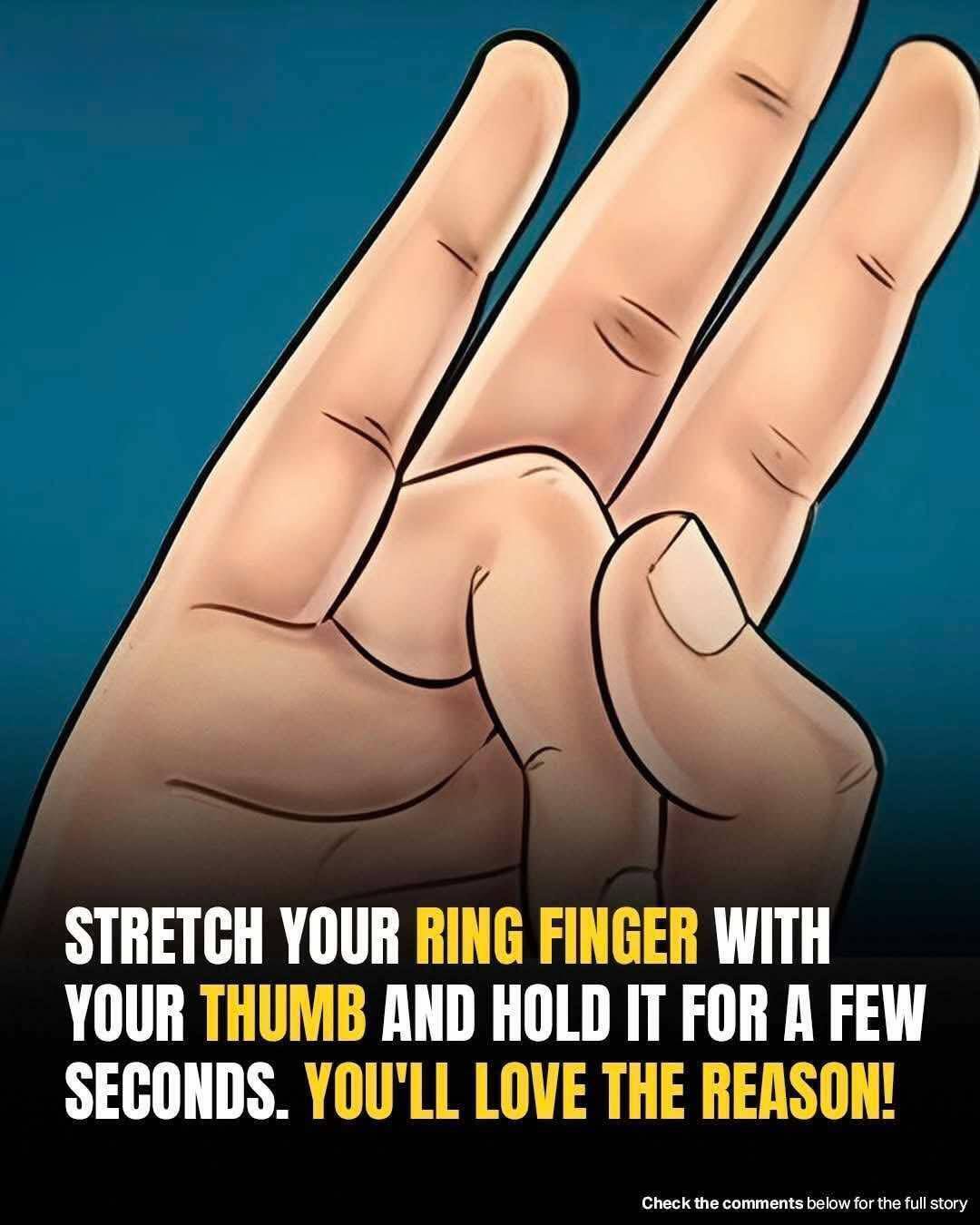
    We rely on our hands constantly, often without realizing just how much work they do or how much strain they quietly absorb. From the moment we wake up, our hands are in motion—turning off alarms, preparing breakfast, getting dressed, handling devices, and starting the day’s tasks. Throughout the day, they type emails, grip steering wheels, prepare meals, carry bags, open doors, scroll endlessly across screens, and perform thousands of tiny motions so routine that we barely register them. Yet each of those movements requires coordination between muscles, tendons, nerves, and joints. Over time, the tension from these repeated actions builds slowly, often going unnoticed until a moment of stillness reveals just how fatigued our hands have become.

    This is why something as small as stretching a single finger—especially the ring finger—can feel unexpectedly soothing. Many people are surprised by the calming sensation that comes with gently pulling, massaging, or stretching this particular finger. What seems like an insignificant gesture actually triggers a cascade of small physical and neurological responses that ease tension and bring instant relief. That moment of comfort is not just in your imagination; there is a genuine reason behind why stretching the ring finger can feel so amazing.

    When you apply light pressure to the base of the ring finger and hold it for several seconds, you’re stimulating tissues that respond extremely well to touch. The ring finger, like the others, contains tendons that originate in the forearm, run through the palm, and extend into the finger itself. These tendons are surrounded by small sheaths that can tighten after repetitive use. A gentle stretch encourages them to glide more smoothly, helping to release tiny points of tension that accumulate from typing, gripping, or tapping. This is why the sensation can feel like a small wave of relaxation moving through the hand.

    Another reason this finger stretch feels so satisfying is linked to circulation. The hands contain many small blood vessels that can become slightly constricted when muscles tighten. When you pull or stretch the finger, even lightly, it can momentarily improve blood flow in the surrounding tissues. This often creates a sense of warmth or a pleasant pulse that signals increased circulation. While it isn’t a medical cure and shouldn’t be used as one, it does offer a simple way to encourage better blood movement through tired hands.

    The ring finger also plays an interesting role in the structure of the hand. It shares tendon connections with the middle and pinky fingers, which means that movement in one often subtly affects the others. When you stretch the ring finger, you may feel sensations not only at the base of the finger but also traveling across the palm or radiating into neighboring fingers. This interconnectedness makes even a small stretch feel more significant than expected, almost like a chain reaction of relief spreading throughout the hand.

    Pressure points also contribute to this pleasant effect. In various long-practiced traditions—including reflexology, acupressure, and hand yoga—the fingers are believed to correspond with different energy pathways or emotional states. While these systems are not grounded in modern medical science, many people still find the techniques soothing and helpful for relaxation. According to these traditions, applying gentle pressure to the ring finger may support calming emotions, steady breathing, and balance within the body. Whether or not you follow these philosophies, the act of pressing or stretching the finger undeniably creates a moment of physical and mental grounding.

    Beyond the physical relief, the mental and emotional benefits of this small motion are equally important. When you stop to stretch your fingers—even for just a few seconds—you interrupt the cycle of constant activity and give yourself a micro-break. This tiny pause in the day creates room to reconnect with your body, breathe more deeply, and reset your mind. In the rush of daily responsibilities, moments like these can help reduce stress and promote mindfulness without requiring a major time commitment.

    The tactile nature of the stretch also provides sensory feedback. Feeling the gentle pull on the skin, the slight movement of the joint, and the subtle loosening of tension encourages you to focus on the present moment. This can help quiet mental noise and bring a sense of calm, much like squeezing a stress ball or practicing a quick breathing exercise. Repetitive hand-based relaxation techniques have long been used to soothe nervous energy, and stretching the ring finger is a simple, natural extension of that idea.

    Even though this motion brings relief, it’s important to remember that it is not intended as a medical treatment. If someone experiences persistent hand pain, numbness, swelling, or difficulty moving the fingers, they should speak to a medical professional. However, for everyday tension that comes from using the hands too much, gentle stretches can be a helpful way to counteract stiffness and maintain comfort. It’s similar to stretching your neck or shoulders after sitting too long—small but surprisingly effective.

    Incorporating finger stretches into your daily routine doesn’t require special tools, time, or preparation. You can do it while reading emails, waiting at a stoplight, relaxing on the couch, or getting ready in the morning. The key is gentleness; the motion should never feel painful. Ideally, slowly pull the ring finger upward, rotate it slightly, or massage the base where tension tends to accumulate. A few seconds of mild stretching is usually enough to feel a difference.

    Over time, these short hand-care habits can help counterbalance the strain caused by long hours of typing, gripping, or repetitive manual tasks. Many people notice that their hands feel more flexible and less tired when they regularly stretch the fingers and palms. It also encourages greater awareness of how often we use our hands and reminds us to give them the care they deserve. Since we rely on our hands for nearly everything, taking these small steps can contribute meaningfully to overall comfort and mobility.

    Ultimately, the simple act of stretching the ring finger stands out because of its surprising ability to ease both physical tension and mental stress. It’s a tiny gesture with a big impact—a reminder of how connected the body is and how small movements can create a sense of wellbeing. Whether you’re working, commuting, relaxing, or just taking a quick break, this easy motion offers a moment of comfort in the middle of a busy day.

    Your hands work tirelessly for you. Offering them small moments of release—even something as simple as a gentle finger stretch—can help restore balance, reduce strain, and leave you feeling just a bit more relaxed and at ease.

  • Dalai Lama speaks out after his name appears in Epstein files

    Dalai Lama speaks out after his name appears in Epstein files

    Dalai Lama Responds to Mentions in Epstein Files

    Recent releases of documents related to Jeffrey Epstein have drawn renewed public attention, including references to the Dalai Lama that appear repeatedly in the files. In response, representatives for the spiritual leader have issued a clear statement denying any personal connection to Epstein.

    Documents released by the U.S. Department of Justice between December 2025 and January 2026 contain more than 150 mentions of the Dalai Lama’s name. These references have prompted questions online, despite the absence of evidence showing any direct relationship.
    What the Documents Contain

    According to reporting by China Global Television Network, several emails in the released files include mentions of events where the Dalai Lama was allegedly expected to appear.

    In one message, an unidentified sender wrote about possibly attending a gathering “on the island” where the Dalai Lama was said to be present. Another email stated, “Going now to the event with the Dalai Lama.” However, none of the documents confirm that the individual actually met or interacted with him.

    The Dalai Lama is known for attending large international conferences and religious gatherings, making his name a frequent reference point in correspondence related to public events.
    Emails About Possible Meetings

    The files also include messages in which Epstein and associates discussed attempts to arrange social or academic gatherings involving prominent figures.

    In a 2014 email, Epstein wrote to Soon-Yi Previn about working on a possible dinner involving the Dalai Lama, Woody Allen, and Noam Chomsky.

    Another email from physicist Lawrence Krauss asked about a potential dinner including the Dalai Lama and Allen. No records show that such meetings took place.
    Official Statement from the Dalai Lama’s Office

    In response to speculation, representatives for Dalai Lama issued a public statement on X:

    “We can unequivocally confirm that His Holiness has never met Jeffrey Epstein or authorized any meeting or interaction with him.”

    The statement emphasized that references in third-party emails do not indicate any personal involvement.
    Past Claims and Media Commentary

    In 2025, journalist Michael Wolff claimed on a podcast that he had seen the Dalai Lama at Epstein’s Manhattan residence. He later acknowledged that he could not confirm the nature of any such encounter.

    Another journalist, Jacob Silverman, analyzed the claim independently and noted that no documentation supports a confirmed meeting between Epstein and the Dalai Lama.

    To date, no official records, photographs, or verified witnesses have established that the two men ever met.
    Context: Public Figures and Philanthropic Events

    Observers note that Epstein frequently sought associations with well-known intellectuals, scientists, and spiritual leaders, often through invitations, proposals, or informal correspondence.

    In some cases, public figures were referenced in emails without their knowledge or consent. Legal experts and investigators have repeatedly cautioned that mentions in correspondence do not imply participation or wrongdoing.

    The Dalai Lama has previously participated in large-scale speaking engagements and charitable events organized by third parties, some of which were later linked to controversial sponsors.

    One example often cited is a 2009 event connected to NXIVM, founded by Keith Raniere. Raniere was convicted in 2019 and sentenced to 120 years in prison. The Dalai Lama’s appearance at that event was later criticized, though no wrongdoing was attributed to him personally.
    Congressional Review of Unredacted Files

    Members of Congress have begun reviewing unredacted versions of the Epstein-related documents to determine whether relevant information was previously withheld. Lawmakers may now copy and analyze materials as part of ongoing oversight.
    So far, no official investigation has identified the Dalai Lama as having any personal or professional relationship with Epstein.
    Emphasis on Caution and Accuracy

    Legal analysts and journalists continue to stress the importance of careful interpretation of the files. Many names appear in the documents simply because Epstein referenced them, sought introductions, or discussed potential contacts.

    Being mentioned in correspondence does not indicate involvement in Epstein’s criminal activity.
    Conclusion

    Although the Dalai Lama’s name appears frequently in recently released Epstein-related documents, no verified evidence shows that he met, communicated with, or authorized any interaction with Jeffrey Epstein.

  • If you see window grills with a curve at the bottom here’s what it means

    If you see window grills with a curve at the bottom here’s what it means

    Why Do Some Window Bars Bulge Outward?

    If you’ve ever noticed window bars curving outward like a potbelly, you weren’t just seeing a quirky design — those “potbellied” bars have a practical purpose.

    Originally, window bars were installed to keep homes secure while allowing airflow. Over time, people found that by curving the bars outward, they could also create a bit of extra space — a kind of mini-balcony behind the safety of iron.

    This design allows residents to place flower pots, store small items, or simply enjoy more room for ventilation without compromising security. In densely built neighborhoods, especially in parts of Europe, Latin America, and the Middle East, these curved bars became both a safety measure and a cultural aesthetic.

    So next time you see those bulging bars, know that they’re more than a style statement — they’re a clever blend of utility, tradition, and architectural charm.

  • She Met Someone New at 45—Then the Truth Came Out

    She Met Someone New at 45—Then the Truth Came Out

    When my mom turned 45 and said she had met someone special, I wanted to celebrate her happiness. She had spent her entire adult life raising me on her own, juggling bills, jobs, and responsibilities that rarely left time for romance. Still, when she introduced Aaron, a 25-year-old with an effortless smile and calm confidence, a part of me tensed. I told myself I was being protective, but the truth was simple: I feared she might be stepping into something risky.

    Aaron was charming, helpful, and genuinely attentive. Even so, the age gap gnawed at me, especially when their relationship moved quickly toward marriage. One afternoon, while helping Mom sort papers for the upcoming ceremony, I stumbled upon a locked folder filled with documents. It showed large amounts of debt under Aaron’s name, and a property deed in my mother’s. My heart sank. Every anxious thought I had tried to ignore suddenly felt confirmed.

    I didn’t stop to think. I didn’t gather facts. I marched straight into the wedding rehearsal and publicly accused him of using my mother for money. Silence flooded the room. My mother’s face turned white, and her hands shook. Aaron didn’t defend himself with anger. Instead, he quietly explained that the debts were not for personal gain. They were loans he took out so he and my mother could buy me a small restaurant—something I had dreamed about for years. He planned to work beside me as a pastry chef, building a future we could share as a family.

    In that moment, shame hit me harder than any truth ever had. I realized that my fear of losing the woman who raised me had blinded me to the possibility that someone else could love her—and me—with the same devotion. Sometimes, protecting the people we love means trusting their choices, even when those choices scare us. And sometimes, the courage to believe in someone else becomes the greatest gift we can give.

  • Mysterious Signal Prompts New Search in Savannah Guthrie Family Case

    Mysterious Signal Prompts New Search in Savannah Guthrie Family Case

    Investigators have provided an update in the ongoing search for Savannah Guthrie’s missing mother, confirming that a brief, unusual signal was recently detected. Officials stress that the transmission does not reveal a specific location but has prompted renewed search efforts and cautious optimism. Her exact whereabouts remain unknown as authorities continue their methodical investigation.

    Law enforcement sources said the signal appeared late at night during a routine scan of regional communication frequencies. Investigators described it as weak and fleeting—too limited to generate coordinates but significant enough to warrant immediate attention. Search teams revisited areas linked to earlier tips, carefully re-examining terrain that may have been overlooked. Despite these efforts, no physical evidence has been found, and the signal has not been detected again.

    Authorities are urging the public to maintain perspective. A department spokesperson explained that while the transmission cannot confirm her location, it represents a lead investigators are required to follow. Savannah Guthrie has been informed privately and, according to those close to the family, is staying strong despite the emotional strain. Friends and supporters continue to hope, understanding that searches of this kind often take unpredictable turns.

    Officials are asking the public to avoid speculation while experts analyze the signal to determine its origin. Depending on the findings, search priorities could shift in the coming days. Investigators remain committed to a careful, evidence-based approach that balances speed with accuracy, working tirelessly to uncover answers and bring clarity to a situation that has left her family and the community anxiously awaiting news.

  • High bl00d fat: do not eat these foods in the morning.

    High bl00d fat: do not eat these foods in the morning.

    High bl00d fat, also known as hyperlipidemia, is a common health issue affecting millions of people worldwide. It occurs when there are high levels of fats, such as cholesterol and triglycerides, in the bl00d. If left unmanaged, high bl00d fat can increase the risk of heart disease, str0ke, and other serious health problems.

    One important factor in managing bl00d fat levels is diet, especially the foods you consume in the morning. Breakfast is the first meal of the day, and eating the wrong foods can worsen your bl00d fat levels. Here are some foods you should avoid in the morning if you have high bl00d fat.

    Fried foods, such as fried eggs, bacon, sausages, and hash browns, are high in unhealthy fats and calories. These foods can increase LDL cholesterol, also known as “bad cholesterol,” and raise triglyceride levels. Consuming fried foods regularly can lead to plaque buildup in the arteries, increasing the risk of cardiovascular problems.

    2. Pastries and Sugary Breads

    Pastries, donuts, croissants, and other sweet baked goods are often made with refined flour, sugar, and trans fats. These ingredients can spike bl00d sugar levels and promote the storage of fat in the liver, leading to higher triglycerides. Additionally, many pastries contain butter or margarine, which adds saturated fats, further worsening blood lipid levels.
    3. Full-Fat Dairy Products

    Full-fat milk, cheese, and yogurt are rich in saturated fats, which can raise LDL cholesterol. While dairy is important for calcium and protein, choosing low-fat or skim options is better for individuals with high blood fat. Avoid whole milk or cream-based breakfasts like creamy coffee drinks or cheese-heavy omelets.
    4. Processed Meats
    Processed meats, including ham, salami, and sausages, are high in both saturated fat and sodium. Eating these in the morning may increase cholesterol levels and put additional strain on your heart. Opting for lean protein sources, such as boiled eggs, legumes, or Greek yogurt, is a healthier choice.
    5. Sugary Cereals

    Many breakfast cereals contain high amounts of sugar and refined grains. While they may taste good and be convenient, they can raise triglyceride levels and contribute to weight gain. Choosing whole-grain cereals without added sugar is a safer option.
    Conclusion

    Managing high bl00d fat requires careful attention to what you eat, especially at breakfast. Avoiding fried foods, pastries, full-fat dairy, processed meats, and sugary cereals can help lower cholesterol and triglyceride levels. Instead, focus on eating whole grains, fruits, vegetables, lean proteins, and healthy fats like nuts and seeds. By making smarter breakfast choices, you can protect your heart, maintain healthy bl00d fat levels, and improve overall well-being.