Breaking News

  • 🥑🌟 Crispy Avocado Chips 🌟🥑

    🥑🌟 Crispy Avocado Chips 🌟🥑

    Crispy, flavorful, and made with simple pantry ingredients — these baked avocado chips are a healthier snack you’ll love!

    🛒 Ingredients (Serves 4)

    2 ripe but firm avocados

    ½ cup breadcrumbs or panko

    ¼ cup cornmeal (optional, for extra crunch)

    ½ tsp garlic powder

    ½ tsp paprika

    Salt and black pepper to taste

    2 tbsp olive oil or cooking spray

    🍽️ How to Make Crispy Avocado Chips
    Step 1: Prepare the Avocados

    First, preheat your oven to 200°C (400°F) and line a baking tray with parchment paper.
    Then, slice the avocados into thin wedges or rounds.

    Step 2: Coat the Chips

    Meanwhile, mix breadcrumbs, cornmeal, garlic powder, paprika, salt, and pepper in a bowl.
    Next, lightly brush the avocado slices with olive oil and coat them evenly in the crumb mixture, pressing gently so it sticks.

    Step 3: Bake

    After that, arrange the slices in a single layer on the prepared tray.
    Finally, bake for 18–22 minutes, flipping halfway through, until golden brown and crispy.

    Serve immediately for the best crunch!

    ⭐ Tips for Extra Crispy Avocado Chips

    Firstly, use firm avocados to prevent mushiness.

    Moreover, slice evenly for consistent baking.

    Additionally, avoid overcrowding the tray.

    Finally, let them cool slightly before serving to help them crisp up further.

    🔄 Variations to Try

    Vegan Parmesan: Add 1–2 tbsp nutritional yeast to the crumb mix.

    Spicy: Mix in chili powder or cayenne pepper.

    Gluten-Free: Use gluten-free breadcrumbs.

    Air Fryer: Cook at 190°C (375°F) for 10–12 minutes, flipping halfway.

    Herbed: Add dried oregano, basil, or Italian seasoning.

    💚 Health Benefits

    Avocados provide heart-healthy monounsaturated fats.
    Moreover, they contain fiber and potassium.
    Because these chips are baked instead of fried, they’re lower in excess oil.
    As a result, they’re a nutritious alternative to traditional potato chips.

    🧒 Kid-Friendly Version

    Cut into fun shapes (using firm slices).

    Use mild seasoning only.

    Serve with ketchup or dairy-free ranch.

    Bake slightly longer for extra crunch.

    🥗 Nutrition Facts (Per Serving – Approx.)

    Calories: 180 kcal

    Carbohydrates: 16 g

    Protein: 3 g

    Fat: 12 g

    Fiber: 6 g

    Sugar: 1 g

    Sodium: 210 mg

  • This Photo Looks Innocent — Until You Notice the Detail That Has Shocked Millions

    This Photo Looks Innocent — Until You Notice the Detail That Has Shocked Millions

    At first glance, the image looks like a classic snapshot from a warm summer afternoon: a blonde woman lounging by the pool, sunscreen in hand, a striped swimsuit glowing under the sun. It feels like something straight out of a vintage magazine — carefree, glamorous, and effortlessly iconic.

    But the moment people looked a little closer… everything changed.

    What seemed like a simple photo suddenly became one of the most re-shared “look twice” images online — not because of who she is, but because of what’s hiding in plain sight.

    Viewers who zoomed in noticed something unusual behind her, tucked in the background near the lounge chairs. It wasn’t part of the set, it wasn’t a shadow, and it wasn’t a visual trick. It was a detail so unexpected that thousands of comments quickly flooded in from people who had seen the picture dozens of times but never realized what they were actually looking at.

    Some called it “accidental perfection.”
    Others said it looked like “a scene directors couldn’t recreate if they tried.”
    A few even insisted it had to be edited — until experts confirmed the photo is completely genuine.

    So what is everyone gasping over?

    It’s the optical illusion created by the angle, the light, and the objects behind her. When aligned perfectly, the scene forms a shape that looks like something entirely different — something your eyes notice before your brain can explain it. The photo tricks your mind for a moment, making you believe you’re seeing far more than what’s actually there.

    That’s why this simple poolside picture — taken decades ago — suddenly resurfaced and went viral again. It reminds people how easily the mind can be fooled, and how an innocent moment can unintentionally become unforgettable.

    If you missed it the first time, you’re not alone.
    Most people did… until they looked closer.

  • Why Night Driving Feels Harder Than Ever

    Why Night Driving Feels Harder Than Ever

    It happens in an instant. A car approaches from the opposite direction, the light flares, and for a brief moment the road ahead seems to disappear. Your eyes strain, your hands tighten on the wheel, and a quiet question creeps in: Is something wrong with my vision?

    You’re not alone. More and more drivers report that night driving feels uncomfortable, stressful, and even unsafe. What once seemed manageable now feels like a constant battle against glare, shadows, and momentary blindness. Yet in most cases, the issue isn’t your eyesight at all.

    This growing discomfort is the result of several subtle changes that have quietly reshaped the way we experience the road after dark. While each factor alone may seem minor, together they create a perfect storm for visual fatigue and reduced clarity.

    One of the biggest shifts comes from the evolution of vehicle lighting. Cars today illuminate the road very differently than they did just a decade ago. The goal has been better visibility—but that improvement hasn’t come without unintended side effects.

    Modern headlights, especially LEDs, emit a much brighter and whiter light than traditional halogen bulbs. While this can help drivers see farther ahead, the intensity can be overwhelming for oncoming traffic, particularly on unlit roads or after long hours behind the wheel.

    Brightness, however, is only part of the story. The color of the light matters just as much. Cooler, blue-toned light scatters more easily in rain, fog, or dusty air, creating glare and reducing contrast. This makes it harder for the brain to distinguish road markings, pedestrians, or obstacles.

    Vehicle design also plays a role. Taller vehicles like SUVs and trucks position headlights higher off the ground. When combined with even slight misalignment, their beams can strike directly at eye level for drivers in smaller cars, amplifying discomfort and momentary vision loss.

    Misaligned headlights are far more common than most people realize. Changes in suspension, uneven tire wear, or simply carrying heavy cargo in the trunk can tilt beams upward, turning a helpful light source into a blinding one for others on the road.
    The reassuring part is that drivers aren’t helpless. Simple adjustments can make a noticeable difference. Regularly checking headlight alignment, compensating for heavy loads, and keeping windshields clean—inside and out—can significantly reduce glare and eye strain.

    When faced with intense oncoming lights, shifting your gaze slightly toward the right edge of the road instead of staring directly into the beams can help preserve night vision while maintaining control.As newer technologies like adaptive headlights become more widespread, night driving may gradually become calmer and safer again. Until then, understanding what’s really behind the glare can ease frustration—and remind you that your eyes aren’t the problem.

  • Found an Insect in Your Hair? Safe and Effective Ways to Remove It

    Found an Insect in Your Hair? Safe and Effective Ways to Remove It

    Discovering an insect in your hair can be unsettling, especially when it involves head lice—a common concern for many households. These small parasites often spread easily in group environments such as schools, camps, or shared living spaces through close contact or the exchange of personal items. While the situation can feel stressful, understanding how lice behave and how to remove them safely can make the process far more manageable.

    Head lice are tiny, wingless insects that live close to the scalp, where they feed on small amounts of blood. They lay eggs, known as nits, which attach firmly to the hair near the roots. These eggs can be difficult to remove and are often mistaken for dandruff. Although lice do not spread disease, they can cause persistent itching, irritation, and discomfort if not treated properly. They can also survive briefly away from the scalp, making careful cleaning important.

    Treatment typically begins with a medicated shampoo or lotion specifically formulated to eliminate lice. Following the instructions exactly is essential, as timing and application method directly affect effectiveness. These treatments are designed to kill active lice but may not fully remove nits, which require additional attention.

    After treatment, a fine-toothed lice comb should be used on damp hair to carefully remove remaining lice and eggs. Working in small sections helps ensure thoroughness, and the comb should be cleaned after each pass. Because some eggs may hatch later, a follow-up treatment is usually recommended within 7 to 10 days.

    Household care plays an important role as well. Clothing, bedding, towels, and hair accessories should be washed in hot water and dried on high heat. Items that cannot be washed can be sealed in plastic bags for two weeks to ensure any remaining lice do not survive. Regular scalp checks and avoiding the sharing of personal items can help prevent reinfestation.

    With patience, consistency, and proper care, head lice can be managed effectively. While the experience may be uncomfortable, it is a common issue—and one that can be resolved safely with the right approach.

  • How this little boy turned a violent childhood into TV stardom and millions

    How this little boy turned a violent childhood into TV stardom and millions

    Today, his net worth sits at an estimated $220 million.

    But long before the Michelin stars, the global fame, and the explosive television persona, Gordon Ramsay was just a frightened boy growing up in chaos.

    Long before the red carpets and roaring kitchens, Ramsay’s childhood was marked by instability, poverty, and violence.

    Born in Scotland on November 8, 1966, he was raised in a family constantly uprooted by his father’s erratic behavior. His mother worked tirelessly as a nurse, while his father drifted between jobs — swimming pool manager, welder, shopkeeper — never staying long. The instability wasn’t just financial. It was emotional, volatile, and frightening.

    Ramsay has described his early years as “hopelessly itinerant,” a childhood shaped by constant moving and the looming shadow of an alcoholic father. Weekends, he has said, were often overshadowed by drink.

    “It’s hard, isn’t it, when someone’s an alcoholic?” Ramsay once reflected. “You’re nervous. You’re worried about hitting the end of the bottle… because you know what happens at the end of that.”

    When the Bacardi bottle emptied, so did whatever thin layer of peace existed in the house.

    His father’s violent outbursts frequently cost him jobs. Arguments with neighbors and employers meant the family packed up and started again — over and over. For a child, there was no sense of security. No steady ground.

    Police were sometimes called to remove his father from the home. Social services intervened. There were periods when Ramsay and his siblings were placed in care.His mother, Helen, endured years of abuse. She later revealed she suffered violence for two decades. She married at 17; the abuse began six months later.

    “If his shirt wasn’t ironed properly… or his food wasn’t put on the plate properly… it was an excuse,” she said.

    She tried to shield her children from the worst of it, but children see more than adults realize. Bruises were explained away. Lies were told to protect them.

    “It’s not until they’re older they tell you what they heard and saw,” she later admitted.

    Ramsay has spoken candidly about the emotional damage of those years. In an essay for CNN, he acknowledged that no child should ever feel unsafe in their own home — yet that was his reality.

    He once said of his father, “I had a torrid relationship with him.” When accused of being a snob for wanting more from life, Ramsay replied, “No, definitely not a snob. I just want to get out of the mess I was born in.”

    That desire to escape became fuel.

    As a teenager, Ramsay initially pursued football. But after a knee injury ended that path, he pivoted. At 19, he committed himself fully to the culinary world.

    He began humbly — working as a dishwasher. There were no shortcuts, no privileges. Just grit.

    Eventually, he trained in London under legendary Michelin-starred chef Marco Pierre White at Harveys. The kitchens were brutal, disciplined environments — but they gave him structure and purpose.

    At the same time, his younger brother was battling heroin addiction. Ramsay has admitted that cooking may have saved him.

    “If I didn’t cook my way out of that mess, then I could have gone down with the rest of them,” he told People.

    In 1998, he opened his first restaurant. Within three years, it earned three Michelin stars — making him the first Scot to achieve that distinction.

    From there, the rise was meteoric.

    Television audiences around the world soon met the sharp-tongued, high-pressure chef of Hell’s Kitchen, Kitchen Nightmares, and The F-Word. His temper became iconic. His blunt critiques unforgettable.

    But behind the fiery persona stands a man shaped by survival.

    Today, Gordon Ramsay oversees a global hospitality empire. Much of his wealth flows through Gordon Ramsay Holdings Limited, valued in the tens of millions, with Ramsay holding a majority stake. His business spans restaurants, culinary academies, television production, and branded ventures across continents.

    And then there’s family.

    Ramsay married Tana Hutcheson in 1996. Together, they have six children. He has often said that fatherhood changed him — and that his childhood trauma shaped the kind of parent he strives to be.

    In the Netflix documentary Being Gordon Ramsay, he speaks openly about his upbringing and how it forged his relentless drive.

    “You never take things for granted,” he explained. “You become so appreciative. But there’s also this relentless drive… you never want to lose it.”

    That hyper-awareness — of stability, of loss, of security — still follows him.

    He has also turned his past into purpose. Alongside his wife, he has supported Women’s Aid and helped raise significant funds for domestic abuse survivors — transforming personal pain into advocacy.

    For Ramsay, success was never just about fame or fortune. It was about escape. About protection. About rewriting the story.

    Behind the sharp standards and volcanic outbursts stands a man who grew up in fear — and decided the cycle would end with him.

    From cramped council flats to global empire, Gordon Ramsay’s story isn’t just about cooking.

    It’s about survival.

    And the determination to build a life defined not by where you started — but by where you refused to stay.


  • Vegan Greek Salad (Fresh, Zesty & Dairy-Free)

    Vegan Greek Salad (Fresh, Zesty & Dairy-Free)

    🛒 Ingredients

    4 cups chopped romaine lettuce (or mixed greens)

    1 cup cherry tomatoes, halved

    1 large cucumber, sliced

    ¼ red onion, very thinly sliced

    ½ cup Kalamata olives

    ½ cup vegan feta (store-bought or homemade; see below)

    1–2 tbsp fresh parsley (optional)

    🫒 Greek Dressing (Vegan)

    3 tbsp extra virgin olive oil

    1½ tbsp red wine vinegar (or fresh lemon juice)

    1 tsp Dijon mustard

    1 tsp dried oregano

    1 small garlic clove, minced

    Salt & black pepper to taste

    Whisk everything together until slightly emulsified.

    👩‍🍳 Instructions

    Combine lettuce, tomatoes, cucumber, onion, and olives in a large bowl.

    Add vegan feta and parsley.

    Drizzle with dressing and toss gently.

    Serve immediately, or chill 15–20 minutes to deepen the flavors.

    🧀 Quick Homemade “Tofu Feta” (5 Minutes)

    You’ll need:

    1 block firm tofu (pressed & cubed)

    2 tbsp lemon juice

    1 tbsp olive oil

    1 tsp dried oregano

    ½ tsp salt

    ½ tsp garlic powder

    Toss everything together and let marinate at least 15 minutes (longer = more flavor!).

    ✨ Optional Add-Ins

    Sliced avocado

    Roasted red peppers

    Chickpeas for extra protein

    Quinoa to make it a full meal

    Warm pita bread on the side

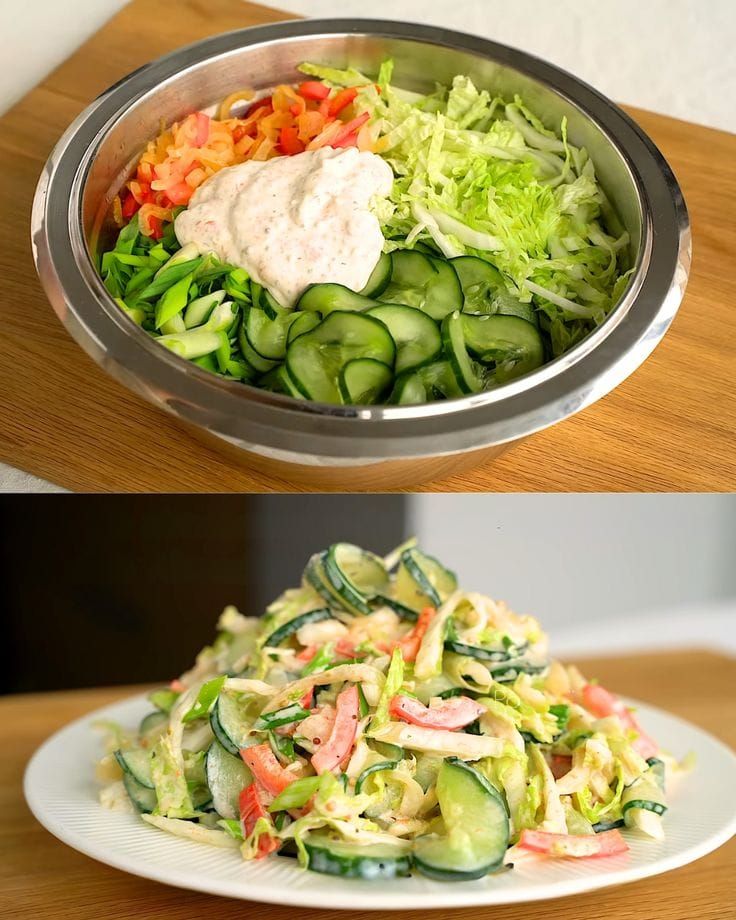
  • Fresh & Crunchy Cucumber Salad (Ready in 10 Minutes!)

    Fresh & Crunchy Cucumber Salad (Ready in 10 Minutes!)

    🌿 Ingredients

    2 large cucumbers (English or Persian work best)

    ¼ red onion, very thinly sliced

    2 tablespoons fresh dill, chopped

    3 tablespoons white vinegar (or apple cider vinegar)

    1 tablespoon olive oil

    1 teaspoon sugar (optional, balances acidity)

    ½ teaspoon salt

    ¼ teaspoon black pepper

    🥣 Instructions

    Slice the cucumbers into thin rounds (or half-moons if large).

    Thinly slice the red onion and add to a bowl with the cucumbers.

    In a small bowl, whisk together vinegar, olive oil, sugar, salt, and pepper.

    Pour the dressing over the vegetables and toss well.

    Sprinkle in the fresh dill and mix gently.

    Let it sit in the fridge for 10–20 minutes before serving for best flavor.

    ✨ Optional Add-Ins

    Crumbled feta cheese

    Cherry tomatoes

    A squeeze of fresh lemon juice

    Thinly sliced radishes

    A spoonful of sour cream or Greek yogurt for a creamy version

    ❄️ Storage Tip

    Store in an airtight container in the refrigerator for up to 2 days. It’s best enjoyed fresh while the cucumbers are crisp!

  • How Sustainable Bathroom Alternatives Are Gaining Popularity

    How Sustainable Bathroom Alternatives Are Gaining Popularity

    Toilet paper is a daily necessity for millions of households, yet few people stop to consider its long-term environmental impact. In recent years, conversations across Western countries, including France, have begun to question whether this familiar product is truly sustainable.

    As awareness of environmental responsibility grows, everyday habits are increasingly being reassessed.

    What was once viewed as an unquestioned staple is now part of a broader discussion about resource use and waste. Modern toilet paper was introduced in the 19th century and quickly became a standard around the world.

    However, its production requires large quantities of trees, water, and energy, placing strain on natural resources and contributing to pollution.

    Some studies have also examined the presence of chemical residues in certain paper products, prompting consumers to take a closer look at the materials they use regularly.

    While safety regulations exist, these findings have encouraged more mindful choices. This shift in awareness has fueled interest in alternative hygiene practices. In many regions, washing with water has long been common and is often considered both hygienic and environmentally friendly.

    The growing popularity of bidets reflects this trend, particularly as modern models become easier to install and use. In countries like Japan, water-based toilet systems are already widely adopted.

    Reusable fabric alternatives have also gained attention as a way to reduce waste and household costs over time. Although change may take time, the future of personal hygiene is increasingly focused on sustainability, efficiency, and thoughtful consumption.

  • Understanding a Common Body Response and Its Role in Urinary Health

    Understanding a Common Body Response and Its Role in Urinary Health

    Many daily actions happen automatically, from blinking to stretching, and these responses often serve to protect our health. While they may seem trivial, ignoring them can lead to discomfort or complications over time. One such natural response is the urge to urinate after physical closeness, particularly common in women. This instinct is a protective mechanism that supports urinary health.

    The human body constantly responds to internal and external changes without conscious effort. During physical activity or intimacy, blood flow increases in the pelvic area, muscles relax, and hormones shift. These changes help tissues recover, maintain circulation, and protect sensitive areas. The urge to urinate signals the body to cleanse the urinary tract and restore balance.

    Physical movement in the pelvic region can put gentle pressure on the bladder, activating nerve pathways that prompt urination. Kidney activity may increase slightly, producing more urine, while hormones associated with relaxation and bonding influence fluid regulation. These normal responses ensure the body maintains equilibrium after intimacy.

    Urinating promptly helps reduce the risk of urinary tract infections by flushing bacteria away from the urethra before they reach the bladder. Women are more susceptible due to a shorter urethra and proximity to bacterial sources, making preventive habits particularly important.

    Beyond infection prevention, urination supports overall cleanliness of the urethra and surrounding areas. Increased blood flow during activity makes tissues more resilient, and urination helps restore baseline conditions while reducing irritation or inflammation.

    Urine may appear lighter or have a milder odor after activity, reflecting hydration and temporary hormonal changes. These variations are normal and not cause for concern. The key is responding to the body’s signals rather than delaying urination.

    Ignoring this natural urge allows bacteria more time to multiply, increasing infection risk. Individuals with conditions like diabetes may be more vulnerable, highlighting the importance of prompt attention to bodily signals.

    Incorporating urination into daily routines, alongside hydration, hygiene, and regular checkups, strengthens the body’s natural defenses. Recognizing and respecting these automatic responses is a simple, effective way to maintain long-term urinary health.

  • Boiled vs. Fried Eggs: Which Makes the Healthier Breakfast?

    Boiled vs. Fried Eggs: Which Makes the Healthier Breakfast?

    Boiled and fried eggs are two popular breakfast choices, each offering different benefits for energy and overall nutrition. Eggs in general are valued for their protein content, quick preparation, and ability to keep you full, making them a reliable morning meal for people with busy schedules. Understanding the differences between boiled and fried eggs helps determine which option better supports energy levels and wellness.

    Boiled eggs are often considered the healthier option because they require no added oil or butter. This keeps their calorie and fat content low while preserving their natural nutrients. With roughly 70 calories and 6 grams of protein, a boiled egg offers a lean, steady source of energy that supports muscle repair and weight management without unnecessary additives.

    The nutrient retention in boiled eggs is another advantage. Essential vitamins like B12 and D remain intact, along with choline, a nutrient important for brain function and metabolism. These benefits make boiled eggs both convenient and efficient, especially for those who want a nutrition-packed breakfast that can be prepared ahead of time and eaten anywhere.

    Fried eggs, by contrast, introduce more variability based on cooking method. They are delicious, versatile, and pair well with nutrient-dense foods such as vegetables, whole grains, or avocado. When cooked with minimal healthy oils such as olive or avocado oil, fried eggs remain a strong nutritional choice without excessive added fat.

    However, frying with butter or unhealthy oils increases calories and saturated fat, raising a fried egg’s calorie range to about 90–100 calories. This makes fried eggs slightly heavier than boiled ones, though still nutritious when prepared mindfully and served with healthy sides.

    Overall, boiled eggs are ideal for those seeking a low-calorie, nutrient-dense breakfast that supports long-lasting energy. Fried eggs provide enhanced flavor and texture while still being healthy if prepared properly. Combining both throughout the week offers a balanced approach to nutrition, enjoyment, and sustained morning energy.