Breaking News

  • Doctors Reveal What Really Happens When You Eat Eggs in the Morning

    Doctors Reveal What Really Happens When You Eat Eggs in the Morning

    For years, breakfast has been called “the most important meal of the day.” Amid changing trends—smoothies one year, fasting the next—eggs have stayed a morning staple worldwide. Doctors and nutrition experts now explain what happens in your body when you start the day with eggs.

    Eggs are packed with high-quality protein. “Eating eggs in the morning can help you feel full longer,” nutritionists say. This fullness can reduce mid-morning snacking and keep energy levels more stable.

    Eggs contain nutrients like choline and lutein. According to experts, “Choline is essential for brain function, and lutein supports eye health.” These compounds make eggs more than just a source of calories—they’re brain and eye boosters too.

    Starting the day with eggs may help control weight. Studies show that people who eat eggs for breakfast tend to consume fewer calories at lunch. “Eggs can be a simple, effective part of a balanced diet,” doctors note.

    Eggs are quick to cook and easy to pair with other healthy foods. Whether boiled, scrambled, or poached, they fit many diets and taste preferences. Experts remind, “Incorporating eggs into breakfast is both convenient and nutritious.”

  • Reason why you have noticed more people wearing wired headphones (and it’s not what you think)

    Reason why you have noticed more people wearing wired headphones (and it’s not what you think)

    Wired headphones are reappearing in everyday life, and the shift goes beyond nostalgia. After years of wireless earbuds dominating commutes and workouts, many people are returning to cables for practical reasons rather than sentiment alone.

    Convenience is often the first advantage mentioned. Wired headphones require no charging or pairing and remove the frustration of misplaced earbuds. They work instantly, appealing to users who are tired of managing battery life across multiple devices.

    Social media has also fueled the comeback. Wired headphones frequently appear in short-form videos and street-style photos as a visible throwback accessory, combining retro aesthetics with everyday functionality.

    Some users say they feel more comfortable limiting constant Bluetooth exposure. Although wireless audio relies on low-power radiofrequency signals commonly used in many devices, online discussions about potential health effects have influenced personal decisions.

    Most claims linking Bluetooth to serious illness are not supported by strong scientific evidence at typical consumer exposure levels. However, the debate has encouraged people to reflect on how often they depend on wireless technology.

    Experts stress that the greater risk involves volume and listening time. Whether headphones are wired or wireless, prolonged use at high volume can gradually damage hearing. Keeping sound at comfortable levels, taking breaks, and monitoring exposure matter far more than the type of device itself.

  • Sarah Palin Sparks Online Discussion After New Public Photos

    Sarah Palin Sparks Online Discussion After New Public Photos

    Before national attention, Sarah Palin’s life was centered on Alaska and family. As the article notes, “much of her story is rooted in family life and years spent in Alaska.” She and her husband focused on raising five children, balancing responsibilities, and keeping routines steady despite growing public visibility. Even as public service expanded her profile, “they worked to keep their private world grounded and protected from outside pressure.”

    After more than three decades together, her marriage to Todd Palin ended suddenly. The divorce followed “a sudden legal notification,” closing a partnership that began in youth. The split marked “a significant personal transition,” unfolding under intense public observation. Despite this, the article emphasizes that “the focus for both individuals remained on family stability and mutual respect.”

    In the aftermath, she turned toward restoring balance and routine. According to the article, “she redirected her energy toward rebuilding daily structure and personal balance.” Support from friends, relatives, and community ties proved essential, helping her “reestablish routines and pursue interests that had long been part of her identity.” Progress came through consistency and connection rather than sudden change.

    Today, her perspective highlights endurance and growth. She reflects “resilience and gratitude for lessons learned through change,” emphasizing perseverance, family bonds, and adaptability during transitions. Her experience shows how difficult endings can lead to renewal through reflection, determination, and a continued commitment to personal growth.

  • Zoo Shares New Update on Punch the Baby Monkey After Online Concerns

    Zoo Shares New Update on Punch the Baby Monkey After Online Concerns

    A tiny monkey who captured global attention is steadily improving. Ichikawa City Zoo recently shared updates about Punch, a baby Japanese macaque whose fragile start sparked widespread concern and compassion.

    Born on July 26, 2025, Punch was rejected by his mother shortly after birth. For a species that depends heavily on maternal bonding, this was a serious setback. Zoo staff stepped in immediately, providing round-the-clock neonatal care and structured enrichment to support his development.

    To offer comfort, caretakers placed soft items in his space. Punch formed an attachment to a plush orangutan toy, and photos of him clinging to it quickly went viral, drawing affection — and scrutiny — from around the world.

    In mid-February, a video showed an adult macaque pulling him. Viewers feared bullying. The zoo clarified that the interaction reflected normal troop dynamics during gradual integration. In macaque societies, hierarchy can look harsh but serves social learning.

    Staff emphasized that Punch was not being isolated but carefully introduced to the group. Integration is delicate work, requiring patience and close observation to ensure long-term stability.

    By February 23, progress was visible. Punch was playing with other young macaques, eating independently, and entering the enclosure without clinging to a keeper. Small steps signaled growing confidence.

    Later updates noted he interacted comfortably without relying on the stuffed toy. Letting go of it marked a quiet milestone in his development.

    The zoo also addressed concerns about habitat conditions and minor hair thinning, explaining these as seasonal and manageable. Veterinarians confirmed his health is stable. For now, the simplest truth remains: Punch is integrating, growing stronger each day.

  • A Late-Night Phone Call at 2 AM Turned Into an Unexpectedly Hilarious Moment When a Sleepy Wife Answered a Stranger’s Question Without Thinking, Leaving Her Husband Confused, Curious, and Then in Fits of Laughter After Hearing Her Perfectly Honest but Completely Unhelpful Response

    A Late-Night Phone Call at 2 AM Turned Into an Unexpectedly Hilarious Moment When a Sleepy Wife Answered a Stranger’s Question Without Thinking, Leaving Her Husband Confused, Curious, and Then in Fits of Laughter After Hearing Her Perfectly Honest but Completely Unhelpful Response

    The phone rang at exactly 2:03 a.m., slicing through the quiet of the bedroom like a blade. The kind of ringing that doesn’t just wake you up—it startles your soul out of sleep. Mark and Lisa had been buried in deep, peaceful rest, tangled in blankets, drifting somewhere between dreams and nothingness. Outside, the neighborhood was silent. No cars. No wind. No distant sirens. Just the hum of the refrigerator and the occasional creak of the house settling. Mark had been dreaming about winning a fishing tournament he’d never entered, while Lisa was somewhere in a dream involving a missing suitcase and a very confused cat. When the phone rang, both of them jumped slightly, but Lisa reached for it first out of pure reflex. Still half-asleep, hair stuck to her face, eyes barely open, she answered without checking the caller ID. “Hello?” she mumbled. There was a pause. Then she frowned slightly, listening. “What?” she asked, squinting at the ceiling. Another pause. “How am I supposed to know?” Her voice sharpened just a little. “That’s two hundred miles away.” She rolled onto her side, turned her back to Mark, and hung up. The room fell silent again. No explanation. No follow-up. Just the soft click of the phone returning to its cradle and Lisa immediately drifting back toward sleep like nothing had happened.

    Mark, on the other hand, was now wide awake. His heart was beating faster, not from fear exactly, but from confusion. Two hundred miles away? Who calls someone in the middle of the night asking about something that far away? He stared at the ceiling for a few seconds, replaying her words in his mind. “How am I supposed to know? That’s two hundred miles away.” He turned his head slowly toward her. She was already breathing evenly again. Asleep. Completely unbothered. He cleared his throat softly. No response. He tried again. “Lisa?” Nothing. He nudged her shoulder gently. “Hey… who was that?” She groaned quietly, eyes still closed. “Huh?” “Who called?” he asked. “You said something about two hundred miles.” She shifted under the blanket and sighed. “Some woman,” she murmured. “Asking if the coast is clear.” Mark froze. “The coast?” he repeated. “What coast?” Lisa cracked one eye open. “I don’t know,” she said. “We don’t live near the ocean.” Then she rolled over again. Mark sat up in bed. Fully awake now. “Wait. What do you mean someone asked if the coast is clear?” Lisa waved her hand lazily. “That’s what she said. ‘Is the coast clear?’ Or something like that.” “And you just… answered?” “Yeah. I told her it was far away.” “From what?” “From here,” Lisa replied, already drifting. “Mark… it’s two in the morning.” But Mark’s brain had officially gone into overdrive.

    He sat there in the dark, staring at the wall, imagination running wild. Who calls at 2 a.m. asking if “the coast is clear”? Was it code? Was it a prank? Was someone planning something? Was it a wrong number? Was it… something worse? He picked up his phone and checked the call log. Unknown number. No name. No location. Just a string of digits. That didn’t help. He lay back down, but sleep was impossible now. Every scenario played out in his mind like a low-budget thriller. Maybe it was someone spying on their house. Maybe someone thought they were somewhere else. Maybe it was meant for a criminal. Maybe Lisa had some secret life he didn’t know about. He immediately dismissed that thought and felt guilty for even considering it. Lisa barely remembered where she put her keys most days. Still, the phrase stuck with him. “Is the coast clear?” Who says that anymore? It sounded like something from an old movie. After about twenty minutes of silent overthinking, he gently shook Lisa again. “Babe. Are you sure that’s what she said?” Lisa groaned louder this time. “Yes, Mark. She asked if it was clear. I said I don’t know. Please let me sleep.” “Did she sound… weird?” “Everyone sounds weird at two in the morning,” Lisa replied. “Including you.” Mark sighed and lay back, staring at the ceiling until, eventually, exhaustion pulled him back into sleep.

    The next morning, sunlight poured into the bedroom, and Lisa woke up refreshed and cheerful, completely unaware of the mental marathon her husband had run overnight. She stretched, yawned, and rolled toward Mark. “Morning,” she said brightly. Mark, who had slept badly and dreamed of secret agents hiding in bushes, squinted at her. “Do you remember the phone call?” he asked. She paused. “Phone call?” Then it clicked. “Oh. Yeah. That weird lady.” “Weird lady,” he repeated. “Lisa, that was strange.” She shrugged and got out of bed. “It was probably a wrong number.” “At two in the morning?” “People do weird things,” she said, heading to the bathroom. “Remember when your cousin called us at midnight because he forgot what time zone he was in?” Mark followed her, still unconvinced. “But she asked if the coast was clear.” “Maybe she meant traffic,” Lisa replied, brushing her teeth. “Or weather. Or something.” “Two hundred miles away?” “Mark,” she said through toothpaste foam, “I once called my boss on Sunday thinking it was Wednesday. My brain shuts down at night.” Later that day, Mark told the story to his coworkers. They immediately turned it into something much bigger. One suggested it was part of a smuggling operation. Another said it was clearly espionage. One jokingly asked if Mark was secretly married to a spy. By lunchtime, Mark was more confused than ever.

    That evening, curiosity finally won. Mark decided to call the number back. He waited until Lisa was home and sitting beside him on the couch. “I’m calling,” he said. “Calling who?” she asked. “The mystery woman.” “Why?” “Because I need answers.” He dialed. It rang twice. Then someone answered. “Hello?” It was an older woman’s voice, tired and confused. “Uh… hi,” Mark said awkwardly. “You called this number last night around two in the morning.” There was a pause. “Oh dear,” the woman said. “Did I?” “Yes,” he replied. “You asked if the coast was clear.” Another pause. Then the woman burst out laughing. “Oh my goodness. I am so sorry.” “So… what was that about?” Mark asked. She sighed. “My sister and I were driving overnight from Arizona to visit our cousin. We were exhausted. We were trying to avoid a speed trap near the highway. She told me to call her friend to ask if the police were still there. I dialed the wrong number.” Mark blinked. “So… the coast?” “Highway patrol,” she explained. “We call it ‘the coast’ as a joke. Don’t ask.” Lisa, listening closely now, burst out laughing. “So it was about cops?” she asked loudly. “Yes!” the woman said. “I’m terribly embarrassed.” “No, it’s fine,” Mark replied, relieved. “We thought it was… something else.” “Oh no,” she chuckled. “Just two tired old ladies trying not to get a ticket.” They hung up. Lisa collapsed into laughter. “See?” she said. “Wrong number.” Mark shook his head. “I lost half a night of sleep over that.”

    Later that night, as they lay in bed again, Mark finally relaxed. The mystery was solved. No spies. No secret codes. No hidden drama. Just two sleepy travelers and a misdialed phone number. Lisa snuggled closer to him. “You worry too much,” she teased. “Maybe,” he admitted. “But you answer phones like you’re giving weather reports.” She smiled. “It was two in the morning. My brain was offline.” They laughed quietly together. And as the house settled back into silence, Mark realized something simple but important: sometimes the strangest moments in life aren’t signs of danger or drama. Sometimes they’re just reminders of how funny, random, and unpredictable everyday life can be. A single sleepy sentence, spoken without thought, had turned into a mystery, a story for coworkers, and a memory they’d laugh about for years. And from that night on, whenever the phone rang late, Lisa would grin and say, “Don’t worry. The coast is probably clear.”

  • You’ll Never Guess What Paprika Is Really Made Of — and Why It’s So Good for You: Uncover the Surprising Origin of This Popular Spice, Its Powerful Health Benefits, and How Just a Sprinkle Can Boost Flavor, Metabolism, and Overall Wellness

    You’ll Never Guess What Paprika Is Really Made Of — and Why It’s So Good for You: Uncover the Surprising Origin of This Popular Spice, Its Powerful Health Benefits, and How Just a Sprinkle Can Boost Flavor, Metabolism, and Overall Wellness

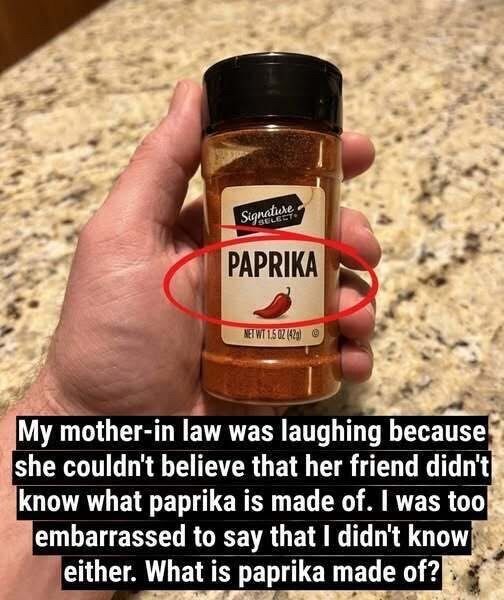
    Sometimes, the most ordinary kitchen moments turn into the best conversations — and the biggest surprises. That’s exactly what happened during a recent afternoon in the kitchen with my mother-in-law. We were prepping ingredients for her legendary goulash, a recipe she’s perfected over decades and guards with equal parts pride and tenderness. The counters were crowded with chopped onions, garlic cloves, and vibrant vegetables waiting to be transformed into something comforting and rich. As I reached for the familiar red tin of paprika, I casually mused out loud, “Isn’t it wild how something so red and flavorful comes from… a root? Or is it bark? Or a seed?” I trailed off, genuinely confused, realizing I actually had no idea what paprika really was or where it came from. It was one of those moments when you suddenly question something you’ve used forever, but never truly thought about.

    She paused mid-chop, her knife hovering over a half-diced tomato as she turned toward me with an expression caught between amusement and disbelief. Then she burst into laughter — the warm, affectionate kind that fills a room like sunlight. “Honey,” she said, shaking her head as if she couldn’t believe the words that had just come out of my mouth, “Paprika is just ground-up red peppers.” I blinked, trying to process her answer, sure I must have misheard. “Wait—what? You mean, like… bell peppers?” She nodded with a smile, enjoying the moment far too much. “Exactly. Sweet red peppers. They dry them, grind them into powder, and voilà — paprika.” She said it as if she were revealing the most obvious fact in the world, while I stood there reconsidering my entire understanding of spices.

    To say I was stunned would be an understatement. I’ve been cooking for years, confidently tossing paprika into stews, eggs, soups, and roasted vegetables, yet never once had I stopped to ask what it actually was. Somehow, in the depths of my imagination, I’d always assumed it came from some exotic spice root or rare dried leaf — maybe something grown in a secluded forest or harvested by monks on a misty mountainside. Something with mystery and ancient lore. But no. Paprika, one of the most vibrant and flavorful spices sitting modestly in almost everyone’s kitchen cabinet, is simply humble peppers — sun-dried, patiently prepared, and ground into fine, fragrant powder. The simplicity of it made me laugh at myself. How could something so ordinary have slipped past my curiosity for so long?

    The revelation didn’t just make me laugh; it made me appreciate paprika in a new way. There’s something delightful about realizing that a spice with such bold personality comes from such an accessible, everyday source. But as my mother-in-law continued explaining, I learned that paprika is far more than just a pretty red powder used to brighten up deviled eggs or add color to a stew. It’s actually packed with nutrients and health benefits that are often overlooked. Paprika contains powerful antioxidants like vitamin A, beta-carotene, and other carotenoids — the same vibrant compounds that give carrots, squash, and sweet potatoes their bright hues. These nutrients play essential roles in supporting healthy vision, reducing inflammation, and protecting the body from oxidative stress. Some studies even suggest carotenoids may help lower the risk of certain cancers and support overall immune function.

    Depending on the specific variety of pepper used, paprika can also contain capsaicin — the fiery compound responsible for the heat in chili peppers. Even small amounts of capsaicin can offer benefits: it has been studied for its potential to relieve pain, boost metabolism, improve circulation, and support heart health. It’s fascinating to think that each sprinkle of paprika doesn’t just deepen flavor, but can also nourish the body in subtle, meaningful ways. We often think of spices as decorative or purely aromatic, but many of them, paprika included, carry quiet nutritional power. As my mother-in-law and I talked, she explained how her grandmother used paprika not just for flavor, but because she believed it “kept the blood strong” — a bit of old-world wisdom that modern nutrition now partly validates.

    From there, our conversation drifted into the different varieties of paprika, each with its own personality and culinary strengths. Sweet paprika is the kind most people recognize — mild, fruity, and versatile, perfect for eggs, roasted vegetables, soups, and classic comfort foods. Smoked paprika, often associated with Spanish cuisine, takes on its signature flavor by being dried over wood fires. This process gives the spice a deep, smoky aroma that elevates dishes like paella, grilled meats, roasted potatoes, and even mac and cheese. Then there’s hot paprika, more commonly used in traditional Hungarian cooking, which brings a gentle but noticeable heat. It doesn’t overwhelm the dish, but instead builds layers of flavor that reveal themselves gradually. Hungarian cooks, my mother-in-law included, often blend different paprikas to create a perfect balance of sweetness, color, and depth. Whichever type you use, you’re not just adding spice — you’re participating in centuries of culinary tradition shaped by climate, culture, and creativity.

    So the next time you sprinkle paprika into your favorite recipe, take a moment to appreciate what you’re really adding — not just a pop of color or a familiar hint of flavor, but a spice with a surprisingly rich story. Paprika carries history in its vibrant redness, from the sunny fields where the peppers ripen to the kitchens around the world where it transforms simple ingredients into something memorable. It’s a reminder that even the most ordinary items in our cabinets can hold delightful secrets waiting to be discovered. Who knew those vivid red specks were simply peppers in disguise, offering both nourishment and flavor in every pinch? And who knows what other everyday ingredients might still surprise us, just waiting for the right moment in the kitchen to reveal what they really are?


  • Scientists Decode the Secret Behind a 117-Year-Old Woman’s Life — and Discover the Surprising Food Linked to Her Longevity

    Scientists Decode the Secret Behind a 117-Year-Old Woman’s Life — and Discover the Surprising Food Linked to Her Longevity

    For centuries, humanity has searched for the secret to a longer, healthier life — but now, one woman’s extraordinary DNA may bring us closer than ever. When scientists began studying the genetic code of Maria Branyas Morera, who lived to the remarkable age of 117, they didn’t just find clues about aging — they uncovered a powerful connection between genetics, lifestyle, and even one everyday food that could help unlock the path to longer lives.

    Born in San Francisco in 1907, Maria lived through two world wars, 21 U.S. presidents, and more than a century of historic change. At just eight years old, she moved with her family to Catalonia, Spain — a journey marked by tragedy when her father died of tuberculosis. Yet Maria thrived in her new home, raising a family and living a quiet but fulfilling life that eventually made her one of the oldest people ever recorded.Family games

    Before her death in 2024, Maria made a rare and generous request: she asked scientists to study her DNA to discover what made her so resilient. Researchers at the University of Barcelona and the Josep Carreras Leukaemia Research Institute accepted the challenge — and what they found amazed them. According to lead scientist Dr. Manel Esteller, Maria’s biology seemed to “separate being old from being sick.” Despite her age, she showed the cholesterol levels, cell activity, and vitality of someone decades younger.Maria’s longevity wasn’t just genetic — her daily habits were key. She avoided smoking and alcohol, stayed active, and remained deeply connected with her family.

    But one detail stood out to researchers: her love for yogurt, particularly the Spanish brand La Fageda. Packed with probiotics known to reduce inflammation and improve gut health, this simple food may have played an unexpected role in keeping her body balanced and strong. Her mornings also included a unique smoothie made from eight different cereals, providing a nutrient-rich start to her day.Further analysis revealed another astonishing clue — Maria’s telomeres, the protective ends of her chromosomes, displayed a pattern rarely seen in someone her age. While most people’s telomeres shorten drastically over time, hers appeared to protect her from cancer and other age-related diseases. Scientists now believe that Maria’s exceptional health was the result of a perfect harmony between her genes and lifestyle. As Dr. Esteller summarized, “The secret to long life is half inherited and half created.”

    Maria’s story continues to inspire millions around the world. Known affectionately as the “Super Grandmother of Catalonia,” she proved that aging gracefully isn’t about avoiding time — it’s about embracing life with balance, kindness, and optimism. Her legacy may one day help science uncover how ordinary habits, like the foods we eat, could help extend not just our years, but the quality of our lives.

  • 1980s Television Star Reflects on Choosing Family Over Career

    1980s Television Star Reflects on Choosing Family Over Career

    At the height of his popularity, it looked like he had everything a young actor could want. Fame came early, fan attention was constant, and his role on the hit sitcom Growing Pains made him one of the most recognizable teen stars of the 1980s. Yet behind the bright studio lights and magazine covers, Kirk Cameron was quietly questioning whether Hollywood was where he truly belonged.

    Acting had opened doors, but it had never been his lifelong ambition, and as the attention grew louder, so did his sense that something was missing from the life others seemed to envy. That uncertainty led to an unexpected turning point. Through an invitation to attend church, Cameron was introduced to ideas about faith, purpose, and responsibility that felt grounding and meaningful.

    Raised without strong religious ties, he did not anticipate how much this experience would reshape his priorities. Over time, his outlook began to change, influencing both his personal life and the professional choices he made. While he continued working, he became more selective, seeking balance over constant spotlight attention.

    In his early twenties, he married his co-star, Chelsea Noble, and together they built a family centered on shared values and stability. They later adopted four of their six children, reflecting their commitment to providing care and opportunity. Eventually relocating to Tennessee, they embraced a quieter lifestyle. Today, he continues working on projects that reflect his beliefs, viewing success as something defined by purpose rather than fame.

  • Defying Age on Her Own Terms: The Most Desired Woman of the 1980s

    Defying Age on Her Own Terms: The Most Desired Woman of the 1980s

    In a world that often glorifies youth and perfection, one Hollywood star has become a powerful symbol of courage and authenticity by embracing the beauty of aging naturally. At 57, she stands firm in her belief that time should be celebrated, not feared. Rather than hiding wrinkles or chasing unrealistic ideals.

    She chooses to wear her years with pride, proving that real confidence and character come from within — not from a surgeon’s touch. Her refusal to alter her appearance has drawn both praise and criticism. Many wonder why she won’t “fix” her lines or cover her gray hair, yet she remains unapologetic. To her, every mark on her face tells a story — of laughter, love, and lessons learned along the way.

    She believes aging is not something to resist but a privilege that reflects strength, resilience, and wisdom gained through life’s experiences. Her message stands out in an industry obsessed with eternal youth, reminding everyone that beauty isn’t measured by flawless skin but by authenticity, self-respect, and the courage to live truthfully.

    She encourages others to stop apologizing for growing older and to embrace each year as a new chapter filled with meaning and grace. The woman behind this inspiring message is Justine Bateman — once one of the most desired women of the 1980s, and now a fearless advocate for aging with pride and dignity.

  • The Answer is in the 1st cᴑmment

    The Answer is in the 1st cᴑmment

    Your Math Skills: The Simple Problem That Keeps Stumping People

    It always starts the same way:

    “Test your math skills.”

    Four harmless words.

    Then comes the equation:

    8 ÷ 2(2 + 2) = ?

    It looks elementary. No fractions. No roots. No algebra.

    Most people answer instantly.

    And many get it wrong.

    Not because they can’t do math — but because they rush.

    Step 1: Read the Whole Problem

    Just like reading a recipe before turning on the stove, you read the entire equation carefully.

    8 ÷ 2(2 + 2)

    The parentheses come first.

    2 + 2 = 4

    Now the equation becomes:

    8 ÷ 2(4)

    This is where people speed up.

    Step 2: Respect the Order of Operations

    Math follows a strict structure:

    Parentheses
    Exponents
    Multiplication and Division (left to right)
    Addition and Subtraction (left to right)

    Notice something important:

    Multiplication and division are equals.

    You solve them from left to right — not based on which one “looks” stronger.

    So now we solve:

    8 ÷ 2 × 4

    From left to right.

    8 ÷ 2 = 4
    4 × 4 = 16

    The correct answer is:

    16

    Why So Many People Say 1

    Some people treat 2(4) as if it must be solved before division, turning it into:

    8 ÷ 8 = 1

    But that assumes multiplication automatically takes priority over division.

    It doesn’t.

    They are processed in order, from left to right.

    The mistake isn’t mathematical inability.

    It’s impatience.

    The Stew Lesson

    This is why the stew metaphor works.

    If you:

    Skip reading

    Assume you know the process

    Rush the heat

    Ignore sequence

    You ruin the dish.

    The equation punishes the same behavior.

    It rewards attention, not speed.

    The Real Solution

    The problem isn’t hard.

    The discipline is.

    Slowing down feels unnecessary — until you realize confidence isn’t the same as correctness.

    The right answer belongs to the person who respects the order.

    8 ÷ 2(2 + 2) = 16

    And that’s the most important ingredient of all.