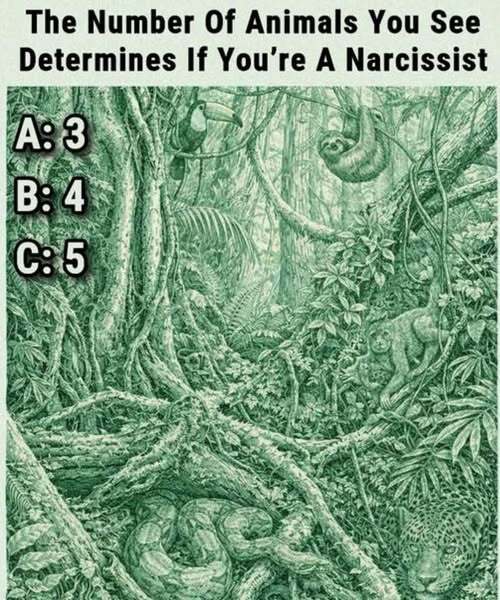
At first glance, the jungle illustration appears to be nothing more than a richly detailed forest scene. Thick, twisting roots stretch across the ground, vines hang from branches, and overlapping leaves form a dense green canopy. The image feels immersive and natural, inviting the viewer to simply admire its artistry. Yet beneath that first impression lies something more deliberate and interactive.
Hidden within the layered foliage are several carefully camouflaged animals blended into the shapes of branches, shadows, and leaves. A bold headline often attached to the image claims that the number of animals you see reveals whether you are a narcissist, typically offering choices such as three, four, or five. The statement is crafted to provoke curiosity and encourage sharing. However, it is not grounded in scientific evidence.
If you look closely, you may begin to notice specific creatures emerging from the greenery. A toucan may be perched along a branch, its beak subtly outlined against the leaves. A sloth can appear suspended from a limb, almost merging with the bark. Near the forest floor, a snake may be coiled in the shadows, while a monkey peeks from behind layered foliage and a jaguar or leopard rests low in a darker corner.
Some viewers immediately identify three animals and stop there, satisfied with what they have found. Others continue scanning and gradually discover more figures as their eyes adjust to the complexity of the illustration. The difference is not about intelligence or personality type. It is largely about attentional focus, patience, and how the brain organizes visual information.
The headline’s reference to narcissism draws on popular fascination with personality labels. In psychology, narcissism exists on a spectrum that includes traits such as confidence, self-focus, and a desire for recognition. At moderate levels, these characteristics can reflect healthy self-esteem and ambition. At higher levels, they may involve grandiosity, entitlement, and reduced empathy.
When narcissistic traits become extreme and inflexible, they may meet criteria for Narcissistic Personality Disorder, a clinically recognized condition. Such a diagnosis requires comprehensive evaluation by a trained mental health professional. It cannot be determined through a single image, quiz, or social media challenge, no matter how engaging it may appear.
Optical illusions like this jungle scene work because the human brain constantly interprets incomplete visual cues. Our perception is influenced by past experiences, expectations, and even temporary factors such as lighting or fatigue. Some people naturally scan broadly for larger shapes, while others focus on smaller details first. These differences reflect normal variations in cognitive processing.
Ultimately, the jungle illusion is a playful exercise in perception rather than a legitimate psychological test. While it may spark conversation or self-reflection, it does not measure narcissism or any other complex personality trait. The number of animals you see says more about how you observe in that particular moment than about who you are at your core.
Leave a Reply