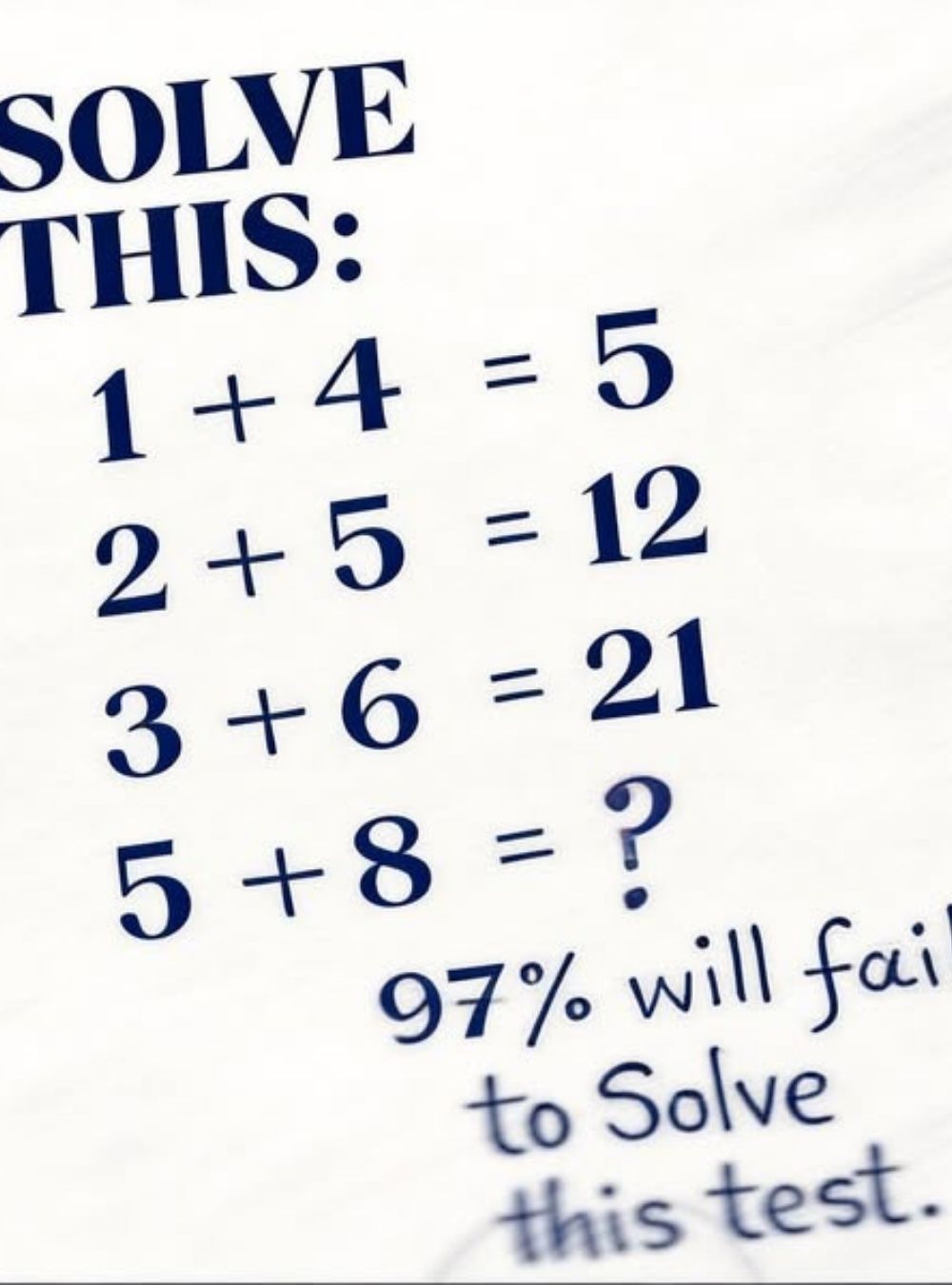
At first glance, it looks easy.
1 + 4 = 5
2 + 5 = 12
3 + 6 = 21
5 + 8 = ?
But something doesn’t add up—literally.
If you try to apply normal arithmetic, the pattern breaks immediately. That’s what makes this puzzle so addictive. It tempts you with simplicity, then forces you to rethink what “addition” really means in this sequence.
Many people online have proposed different logical explanations.
One popular solution uses a “multiply and add” approach:
A × B + A
Let’s test it:
1 × 4 + 1 = 5
2 × 5 + 2 = 12
3 × 6 + 3 = 21
So for the final line:
5 × 8 + 5 = 45
Using this pattern, the answer would be 45.
But that’s not the only reasoning people have found.
Another approach looks at cumulative thinking. Instead of treating each equation separately, it builds on the previous result:
1 + 4 = 5
2 + 5 = 7 → 7 + previous result (5) = 12
3 + 6 = 9 → 9 + previous result (12) = 21
5 + 8 = 13 → 13 + previous result (21) = 34
Following this pattern, the answer becomes 34.
Both solutions are logically consistent—it simply depends on the pattern you choose to recognize.
And that’s exactly why this puzzle spreads so quickly online.
It isn’t really about the final number. It’s about pattern recognition, flexible thinking, and the willingness to question assumptions. Math puzzles like this strengthen analytical reasoning because they require you to look beyond the obvious and explore multiple possibilities.
In the end, whether you arrived at 45, 34, or even another defensible explanation, the real win is the thinking process itself.
So—what answer did you get?
Leave a Reply